
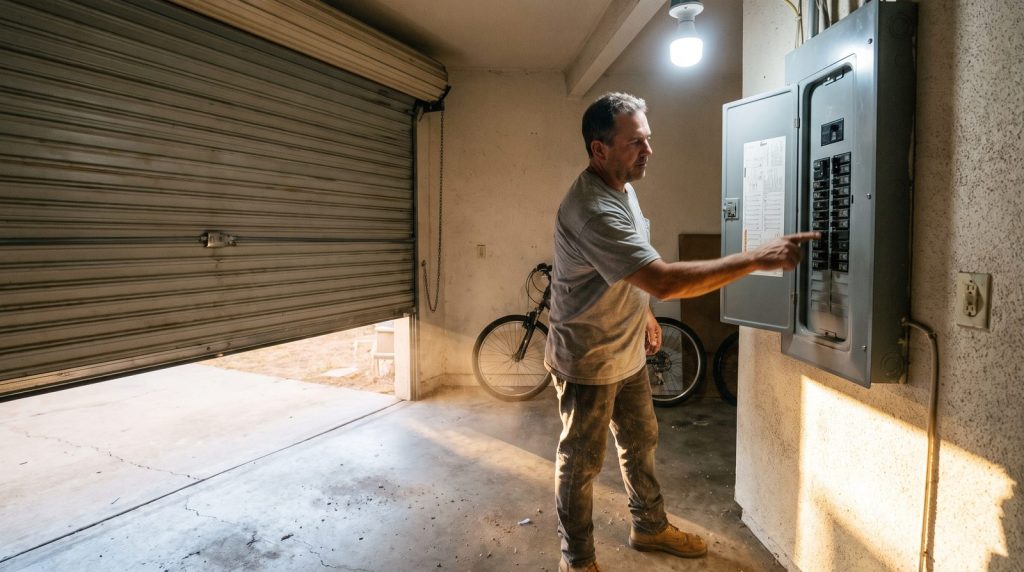
GFCI vs AFCI: Which Protection Does Your Home Actually Need?
People often ask whether the outlet with the TEST and RESET buttons is the same thing as the breaker with a TEST button. It is not. The two look alike and both trip, but they guard against different hazards. A given circuit may need one, the other, or both.
Below: what each device detects, where code calls for each, how dual-function breakers fit in, and how to test them. Code references use the 2023 National Electrical Code (NEC). California adopts the NEC through the California Electrical Code on its own schedule. The California Building Standards Commission lists the 2025 California Electrical Code as the adoption of the 2023 NEC with amendments, effective January 1, 2026. The City of Brea states that plans submitted on or after that date must comply with the 2025 California codes.
What Each Device Detects
A GFCI (ground-fault circuit interrupter) compares the current going out on the hot wire with the current coming back. When the two differ by about 5 milliamps, it shuts the power off in as little as 1/40 of a second, according to OSHA. That missing current is going somewhere, and sometimes it is going through a person.
An AFCI (arc-fault circuit interrupter) listens for something different. The U.S. Consumer Product Safety Commission explains that ordinary fuses and breakers do not respond to early arcing and sparking in home wiring, so by the time one opens, a fire may already have started. The agency sums up the split this way: AFCIs address fire hazards, GFCIs address shock hazards.
Look at the fire numbers. NFPA estimates that in 2015-2019 fire departments responded to an average of 32,620 home fires per year involving electrical distribution and lighting equipment. Those fires caused an average of 430 civilian deaths and 1,070 injuries each year, and arcing was the heat source in 73 percent of them, according to NFPA’s research report. Only 23 percent of those fires happened between midnight and 8 a.m., yet they accounted for 52 percent of the deaths.
Where Code Requires GFCI Protection
For dwellings, the 2023 NEC requires GFCI protection on 125-volt through 250-volt receptacles in these places, per the Minnesota Department of Labor and Industry’s 2023 NEC checklist:
- Bathrooms, kitchens, and laundry areas
- Garages and accessory buildings
- Outdoors, and indoor damp and wet locations
- Basements and crawl spaces
- Within 6 feet of the top inside edge of any sink bowl
- Within 6 feet of the outside edge of a bathtub or shower stall
- Areas with sinks and permanent provisions for food or beverage preparation or cooking, such as wet bars
The device also has to be in a readily accessible location. You can meet the rule with a GFCI receptacle or a GFCI breaker.
Older Orange County homes were built to earlier codes, so some of these locations may have ordinary outlets. The CPSC’s home checklist suggests having GFCIs installed in the locations the NEC lists, including kitchens, bathrooms, garages, unfinished basements, and near laundry tubs and wet bar sinks. For a wider look at which devices belong where, see our guide to switches and outlets for your home.
Where Code Requires AFCI Protection
AFCI rules cover the rooms where people sleep and sit. The same Minnesota checklist, based on the 2023 NEC, says branch circuits supplying 120-volt outlets and devices in dwelling unit kitchens, family rooms, dining rooms, living rooms, parlors, libraries, dens, bedrooms, sunrooms, recreation rooms, laundry areas, closets, hallways, and similar areas must have a listed combination-type AFCI. AFCI protection is also required where wiring or devices in those rooms are modified, replaced, or extended.
Bathrooms, garages, and outdoor outlets do not appear on that list. They sit on the GFCI list instead. The phrase “similar areas” leaves room for judgment, so the building inspector has the final say on borderline spaces.
Existing homes are a gray area for a lot of owners. The CPSC says you may want to consider adding AFCI protection to existing homes, and that older homes with ordinary breakers may benefit most from the added protection against arcing in aging wiring. Installing one is not a homeowner project. CPSC points out that the work involves panel boxes that are usually live even with the main breaker off, so a qualified electrician should do it.
Dual-Function Breakers: When You Need Both
Kitchens and laundry areas appear on both lists. One way to cover them is an AFCI breaker in the panel plus a GFCI receptacle at the outlet. The other is a single dual-function AFCI/GFCI breaker. A Siemens data sheet describes the dual-function breaker as replacing both the arc-fault breaker and the ground-fault receptacle with one device.
A dual-function breaker protects the whole circuit, but you reset it at the panel instead of at the outlet. Cost depends on the brand and your panel type, so ask for a written quote before you decide. Our residential electrical services team can walk the circuits in your home and tell you which approach fits.
How to Test Them Every Month
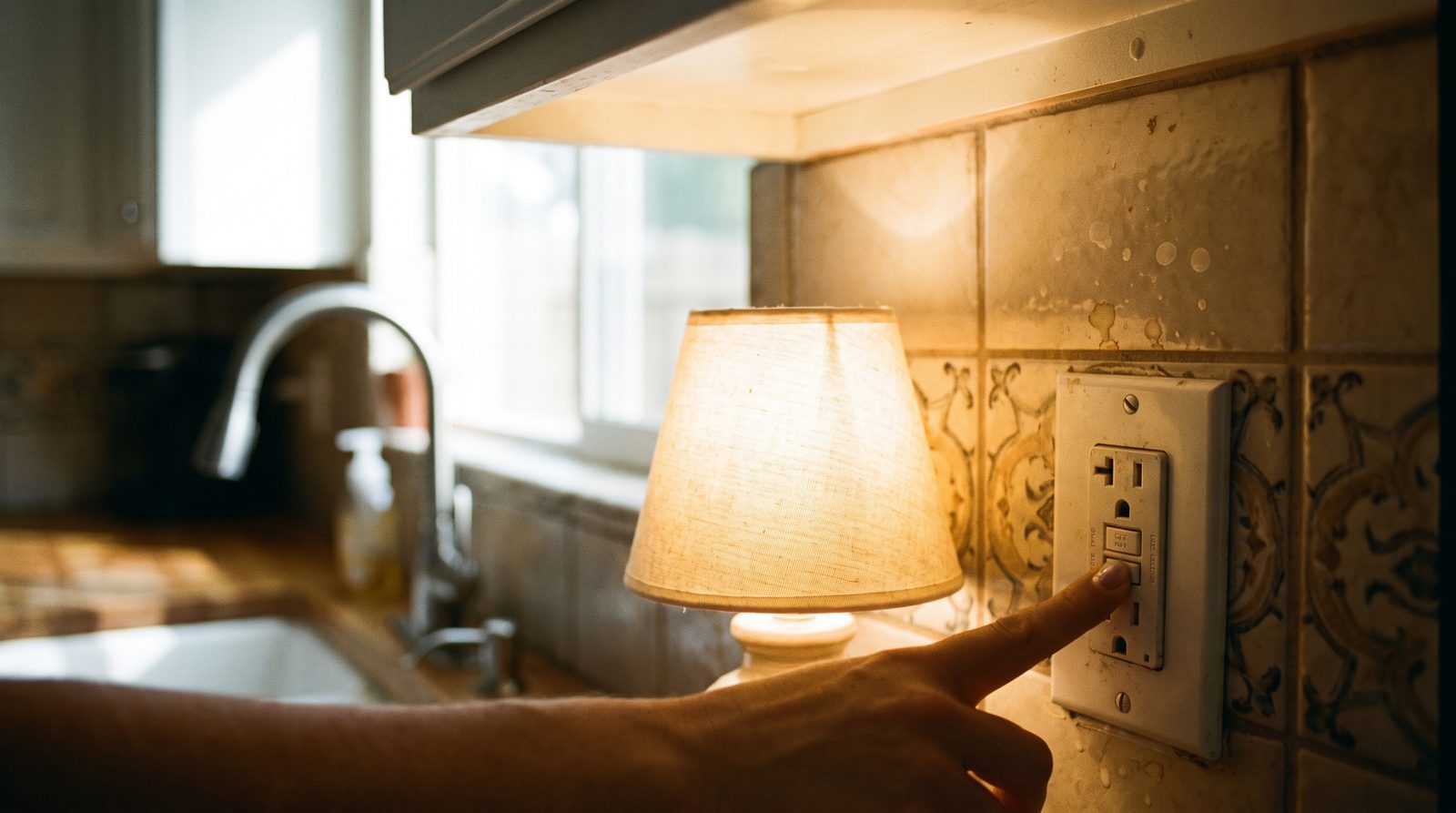
The CPSC recommends testing every GFCI once a month. The steps below follow its home electrical safety checklist and your device’s own instructions, if you have them:
- Plug a light into the outlet and turn it on.
- Press the TEST button. The light should go out.
- Press the RESET button. The light should come back on.
- If either step fails, replace the GFCI.
For AFCI and dual-function breakers, press the TEST button on the breaker face. It should trip. Then reset it. Steps vary by brand, so follow the label printed on your breaker. Siemens recommends testing its dual-function breakers every month, and the same habit makes sense for any AFCI.
Pressing TEST cuts power to everything on that circuit, so save your work and unplug sensitive electronics first. Open the panel door only. Never remove the inner cover of a service panel yourself.
Signs a GFCI or AFCI Is Failing
A GFCI that does not trip on TEST, will not reset, or will not restore power after reset has failed its job and needs replacing. A failed unit can look fine and still deliver power with no shock protection, which is why the monthly test matters.
For AFCI and dual-function breakers, watch for these:
- The TEST button does nothing.
- The breaker will not reset or trips again right away.
- It trips repeatedly with nothing new plugged in.
- A burning smell, discoloration, or a hot cover plate at a protected outlet.
Do not keep resetting a breaker that keeps tripping, and never swap it for a bigger one. Repeated trips can mean real arcing in the wiring, and the CPSC warns that arcing and sparking in home wiring can cause fires. Our guide on reducing the risk of electrical fires covers other warning signs. If you own a business, our commercial electrical services team handles code rules for non-residential spaces, which differ from the dwelling lists above.
If a device fails a test or you are unsure about protection in your own home, contact Brea Electric or call (714) 529-3030. Before touching any wire, turn off the breaker and confirm the circuit is dead with a tester.
Is a GFCI the same as an AFCI?
No. A GFCI protects people from shock by detecting current that leaks off its normal path. An AFCI protects against fire by detecting arcing in wiring. Combination devices exist that do both in one unit.
Do bedrooms need AFCI protection?
Yes. Under the 2023 NEC, bedrooms are on the list of dwelling unit areas where branch circuits supplying 120-volt outlets and devices must have AFCI protection. California adopts the NEC through the California Electrical Code, so your local building department confirms the version that applies.
How often should I test GFCI and AFCI devices?
Once a month. The CPSC recommends monthly GFCI testing, and Siemens recommends monthly testing of its dual-function breakers. Follow the instructions printed on your device.
Can one device provide both GFCI and AFCI protection?
Yes. A dual-function AFCI/GFCI breaker protects against both hazards on one circuit. Kitchens and laundry areas are on both the GFCI and AFCI lists, so they are common places for one.
Does an older home have to add AFCI and GFCI protection?
Code rules apply to new work and to changes made to existing circuits, so an older home may have fewer protected circuits than today’s lists describe. The CPSC suggests considering both devices in existing homes. Ask your building department what applies to your project.
Key Takeaways
- GFCIs protect against shock and AFCIs protect against fire. Neither replaces the other.
- The 2023 NEC lists GFCI protection for kitchens, bathrooms, garages, outdoors, basements, laundry areas, and areas near sinks.
- The 2023 NEC lists AFCI protection for bedrooms, living areas, kitchens, laundry areas, closets, and hallways.
- Kitchens and laundry areas need both, and a dual-function breaker can cover them.
- Test GFCIs monthly, follow your breaker’s label for AFCIs, and replace any device that fails.
References
- California Building Standards Commission (DGS), “January 1, 2026 – 2025 Title 24, Part 3, California Electrical Code (errata)”
- City of Brea, “Building Code Requirements”
- Minnesota Department of Labor and Industry, “Electrical Inspection Checklist for One-Family Dwellings Based on the 2023 National Electrical Code”
- OSHA, “Electrical Incidents – Ground-Fault Circuit Interrupters (GFCI)”
- U.S. Consumer Product Safety Commission, “Preventing Home Fires: Arc Fault Circuit Interrupters (AFCIs)”
- U.S. Consumer Product Safety Commission, “Home Electrical Safety Checklist” (Pub. 513)
- NFPA, “Home Fires Caused by Electrical Distribution and Lighting Equipment”
- Siemens, “Dual Function AFCI/GFCI Circuit Breaker” (data sheet)
From the desk of Brea Electric – Orange County’s electrical contractor since 1932. Visit breaelectric.com or call (714) 529-3030.