
Three-Phase Power Installation: What Orange County Facilities Need to Know
Picture a machine shop that adds a second CNC lathe. The equipment arrives, the electrician runs the wiring, and the single-phase service cannot handle the load. The owner now needs a three-phase conversion that was not in the budget, plus a wait on the utility that pushes back production. This is an illustrative scenario, not a specific client case, but the risk is real whenever a facility adds equipment without checking its electrical service first.
What Three-Phase Power Actually Does Differently
Single-phase power delivers current in one alternating wave. Three-phase power delivers three overlapping waves, offset by 120 degrees. For motors and rotating equipment, this difference matters: three-phase induction motors have high starting torque, a simpler design, and less vibration, and they tend to last longer than single-phase motors used under the same conditions (Wikipedia, Three-phase electric power).
Three-phase motors also tend to be more efficient than single-phase motors, which adds up for facilities with many motors. Actual savings depend on the equipment, so ask for a load and energy review rather than relying on a general figure.
At 480V (a common service voltage for industrial and larger commercial buildings, typically 277/480V), the same load draws much less current than it would on a 240V single-phase circuit, so conductors can be smaller. That reduces conductor cost on large installations and lowers resistive losses in long runs.
The SCE Coordination Process in Orange County
Southern California Edison serves much of Orange County, including many industrial areas, but not every city or every part of every city (it serves a cross-section of Anaheim, for example), so confirm your utility first. Adding three-phase service where only single-phase exists requires a formal SCE service request. Depending on the load and the existing equipment, SCE may need to install or upgrade a transformer or other facilities on its system.
SCE describes a two-step power request process on its Power Requests and Upgrades page: check available capacity, optionally order a Preliminary Capacity Assessment (SCE says the study typically takes 20 to 30 business days once it has payment and complete project documentation), then submit a formal power request with your load requirements and project details. SCE’s Electrical Service Requirements manual covers the service wiring and equipment rules for electrical contractors and engineers.
Total timeline from application to energized service varies with SCE workload, whether SCE must build or upgrade facilities, and your own permits and construction. SCE publishes energization timing targets for the steps it controls: an average of 125 business days for line and service extension projects, and an average of 30 business days for main panel upgrades. Those targets do not include customer-controlled steps such as permits and site construction.
How Industrial Facilities in Orange County Are Served
The three-phase power installation process for a typical Orange County manufacturer involves four major phases: load engineering, SCE coordination, service entrance installation, and internal distribution wiring.
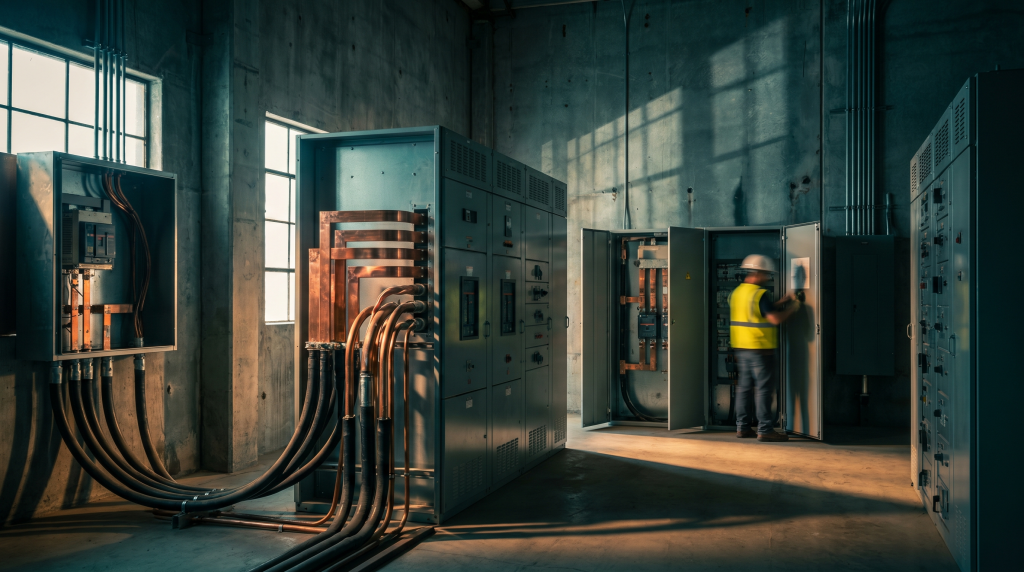
Service entrance equipment for 480V industrial installations typically includes a pad-mounted or overhead transformer, a main meter base, a CT metering cabinet for larger services, and a main distribution panel rated for the service amperage. Brea Electric specifies Square D, Eaton, and Siemens gear with accessible parts and factory support.
Internal distribution and motor control wiring is engineered to NEC Article 430 requirements (California enforces the 2025 California Electrical Code, based on the 2023 NEC, with state amendments, from January 1, 2026), with properly sized overcurrent protection, a disconnecting means in sight of the motor controller and the motor (NEC 430.102 allows limited exceptions, such as a lockable disconnect where a disconnect at the motor is impracticable), and conductor sizing that accounts for continuous-duty motor currents.
Planning a Three-Phase Installation: What to Do First
- Compile your equipment load list. List every motor, machine, and piece of equipment you are planning to run, with nameplate voltage, horsepower, and duty cycle.
- Submit the SCE pre-application early. SCE’s capacity review and any utility-side construction are often the longest-lead items in the project. Submit it while you are still planning the installation.
- Determine your metering configuration. Larger services generally use instrument-transformer (CT) metering rather than direct-socket metering. SCE’s Electrical Service Requirements manual sets the metering requirements for your service size, so confirm them early.
- Plan the service entrance location. NEC 230.70 requires the service disconnect at a readily accessible location outside the building or inside nearest the point of entry, and NEC 110.26 requires working space around the equipment. SCE’s requirements add their own rules for meters and service equipment.
- Coordinate with equipment delivery schedules. Three-phase service activation is a date-certain milestone. Build in buffer.
Frequently Asked Questions
What does three-phase power installation cost in Orange County?
Cost depends on service amperage, the length and type of service run, switchgear and metering equipment, internal distribution scope, and whether SCE must build or upgrade facilities on its side. Get a written quote after a load calculation, and ask SCE for its project cost determination for any utility-side work.
Can single-phase equipment run on a three-phase service?
Yes. Single-phase loads such as office equipment, lighting, and receptacles run on single-phase circuits derived from the three-phase system. The voltages available depend on the service (for example 120/208V or 277/480V), and a 480V service typically needs a step-down transformer to supply 120V loads.
How long does SCE take to approve a new three-phase service in Orange County?
The answer depends on the project. SCE publishes energization timing targets for the steps it controls, and an optional Preliminary Capacity Assessment typically takes 20 to 30 business days once SCE has payment and complete documentation (SCE Power Requests and Upgrades). Starting the SCE process early is one of the most important scheduling decisions a facility manager can make.
Is 480V three-phase required for all industrial motors?
No. The motor nameplate decides. Larger motors are commonly supplied at 480V, while smaller motors and some equipment run on 208V or 240V three-phase. Check the nameplate voltage of every machine on your equipment load list before sizing the service.
Does Brea Electric handle the SCE application process?
Yes. Brea Electric manages the SCE pre-application, load letter submission, and service agreement coordination as part of the project scope. The firm handles all required permits and coordinates the final SCE energization inspection. Contact us at breaelectric.com for a free site assessment.
Key Takeaways
- Three-phase motors have high starting torque, vibrate less, and tend to last longer than single-phase motors, which is why large industrial equipment is built for three-phase supply.
- SCE’s capacity review and any utility-side construction are often the longest-lead items in an industrial power upgrade. SCE publishes timing targets for the steps it controls.
- Submit the SCE pre-application before finalizing equipment purchase commitments to avoid production delays.
- Check the nameplate voltage of every machine before sizing the service. Larger motors are commonly supplied at 480V.
- Brea Electric handles the full scope including SCE application, permits, service entrance installation, and motor control wiring through final inspection.
References
- Wikipedia, Three-phase electric power
- Southern California Edison, Power Requests and Upgrades
- Southern California Edison, Electrical Service Requirements (ESR) manual
- Southern California Edison, Energization Process Steps and Project Timing
- Southern California Edison, Orange County communities served
- Electrical Construction & Maintenance, NEC Requirements for Services Part 2 (NEC 230.70)
- Electrical Construction & Maintenance, Stumped by the Code: Disconnects for Motors (NEC 430.102)
- California Department of General Services, Building Standards Commission: California Building Standards Code
From the desk of Brea Electric. Orange County’s oldest electrical contractor, serving commercial and industrial customers since 1932. License C10. breaelectric.com