
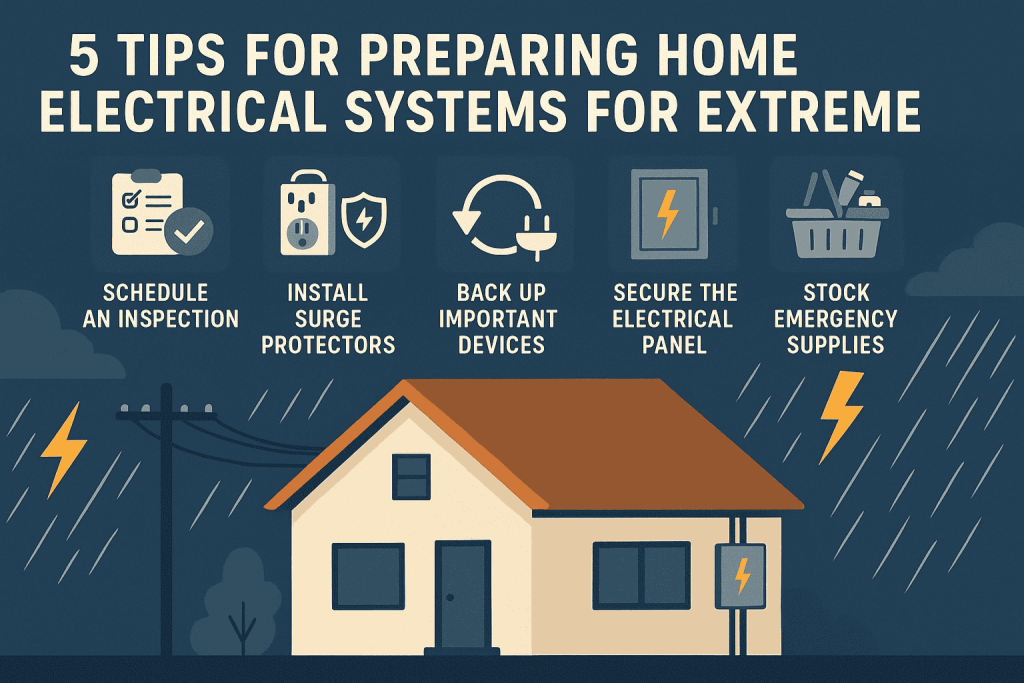
5 Tips to Protect Your Home Electrical System Before Extreme Weather Hits
Southern California’s electrical infrastructure faces increasingly severe weather stress. The 2023 and 2024 winter storm seasons brought high-wind events that downed utility lines across Orange County, producing voltage spikes and extended outages. Summer heat waves pushed grid demand above 50,000 megawatts on multiple days, causing SCE to issue rotating outage warnings. When utility voltage surges, drops, or returns suddenly after an outage, residential electrical systems absorb the impact — and unprepared homes pay for it in damaged appliances, tripped breakers, and in the worst cases, fire from a saturated arc-fault circuit.
Tip 1 — Install Whole-House Surge Protection Before the Season Changes
A plug-in surge protector handles small surges at the device level. It does nothing to protect appliances without surge strips, HVAC equipment, water heaters, or any hardwired system. Whole-house surge protection installs at the service panel and intercepts surges before they reach any branch circuit in the home.
A 2022 study published in the IEEE Transactions on Power Delivery found that utility-side voltage transients during grid restoration after outages exceeded 400V on 120V circuits in 17% of measured events — well above the 330V clamping voltage of most plug-in surge strips. Panel-mounted Type 1 and Type 2 surge protective devices (SPDs) provide a second stage of protection that absorbs the high-energy transients that pass through plug-in devices.
The NEC 2020 edition (adopted in California effective 2023) requires whole-house SPDs on all new residential construction and service upgrades. For existing homes not subject to new construction requirements, adding an SPD to the main panel is a voluntary upgrade that typically costs $300–$600 installed — a fraction of a single HVAC unit replacement.
Tip 2 — Verify GFCI Protection in All Moisture-Exposed Areas
High-wind storms drive water into garages, under exterior doors, and into crawl spaces. Flooding events, even minor ones, create ground fault conditions at any outlet, appliance, or connection point contacted by standing water. GFCI protection trips within 1/40th of a second on a 5-milliamp ground fault — the threshold below which most adults survive contact.
California code requires GFCI protection at all kitchen countertop outlets, bathroom outlets, garage outlets, exterior outlets, crawl space outlets, unfinished basement outlets, and any outlet within 6 feet of a sink. Existing homes are not required to retroactively add GFCI to pre-code outlets unless a circuit is modified, but verifying coverage before storm season is straightforward: use a GFCI outlet tester (available at any hardware store) on every outlet in the listed locations and press the TEST button on each GFCI device to confirm it trips and resets.
According to the NFPA, ground fault protection prevents an estimated 75% of electrocution deaths that occur from consumer products. In storm conditions, GFCI protection is the most direct line of defense against electrical contact fatality in water-contacted areas.
Tip 3 — Have Your Service Entrance and Weatherhead Inspected
The service entrance is the point where utility lines connect to your home — the weatherhead (the curved conduit at the roof), the service entrance cable running to the meter, and the meter base itself. High-wind events pull on service drop cables, which can loosen weatherhead connections or, in severe cases, pull the service entrance cable off the house.
A loose weatherhead connection creates an arcing fault at the service entrance — a high-energy arc that can ignite roofing material. Unlike a branch circuit fault that trips a breaker, a service entrance arc is upstream of the main breaker and cannot be cleared by any device inside the home. It requires utility disconnection to extinguish.
Brea Electric’s residential panel upgrade service includes a full service entrance inspection as a standard component. For customers not scheduled for panel work, a pre-season service entrance check typically runs under $150 and addresses weatherhead attachment, drip loop adequacy, meter base condition, and service entrance cable clamp integrity.
Tip 4 — Install a Generator Interlock or Transfer Switch Before You Need a Generator
Portable generators become common during extended outages. They also become a source of backfeed injuries if connected without a proper transfer mechanism. Backfeed occurs when a generator connected through an extension cord to a house circuit sends voltage back out to the utility lines — lines that utility workers assume are de-energized during restoration work.
A generator interlock kit installs at the main panel and mechanically prevents the main breaker and the generator input breaker from both being closed simultaneously. It is a code-compliant, low-cost ($50–$200 plus installation) solution that eliminates the backfeed path. A whole-house transfer switch provides a more complete solution — isolating the home from the utility entirely when generator power is selected — and enables a larger portion of the home’s loads to be managed during an outage.
Brea Electric installs generator interlocks, manual transfer switches, and automatic transfer switches for both residential and commercial applications. Our 24/7 emergency electrical response service is available when weather-related damage requires immediate assessment or repair.
Tip 5 — Check and Label Your Electrical Panel Before an Emergency
During an extended outage with generator power, someone needs to selectively disconnect non-essential 240V loads to stay within the generator’s capacity. During a flood, someone may need to shut off specific circuits to de-energize areas while maintaining power to others. Both situations require a clearly labeled panel where every breaker’s circuit is identified accurately.
Panel labeling takes one to two hours with two people — one at the panel toggling breakers, one walking the home confirming which outlets and fixtures lose power. Label every breaker. A label like “garage outlets + exterior lights” is more useful than “garage.” Note any multi-wire branch circuits (two hot wires sharing one neutral) where both poles must be shut off together.
- Turn off all breakers, then turn them back on one at a time.
- Have a helper identify what loses power each time.
- Write the circuit description on a label affixed inside the panel door.
- Photograph the completed panel directory and store it on your phone.
- Mark any double-pole breakers serving 240V loads (dryer, range, HVAC, water heater, EV charger).
What is a whole-house surge protector and do I need one?
A whole-house surge protector is a device installed at the service panel that intercepts voltage transients before they reach any branch circuit. It protects hardwired appliances, HVAC systems, and any device without a plug-in strip. The 2020 NEC requires them on new construction. For existing homes in storm-prone areas, they are a cost-effective investment — typically $300–$600 installed.
How do I safely use a portable generator during a power outage?
Never connect a portable generator directly to a house circuit without a generator interlock or transfer switch — this creates a backfeed hazard that can injure utility workers. Run extension cords from the generator to individual appliances, or install a generator interlock kit at the panel for safe connection. Keep generators at least 20 feet from the house and never operate them indoors or in an attached garage.
What should I do after a power outage before turning everything back on?
Turn off all major appliances (HVAC, refrigerator, washer) before power is restored. When power returns, wait several minutes for the utility voltage to stabilize, then turn on appliances one at a time. This prevents the simultaneous inrush current from multiple large loads from tripping your main breaker. Check for any burning smell or visible damage before restoring sensitive electronics.
How can I tell if my electrical system was damaged by a storm?
Signs of storm-related electrical damage include: breakers that won’t reset, outlets that no longer work on a circuit that was functional before the storm, a burning smell at the panel or in walls, visible scorch marks on outlet covers, or a meter base that is pulled away from the wall. Any of these conditions warrants a licensed electrician evaluation before continued use.
Does homeowner’s insurance cover storm-related electrical damage?
Most standard homeowner’s policies cover lightning strike damage and resulting electrical fires. Surge damage from grid events (not direct lightning) is covered by some policies but not all, and coverage often requires documentation of the surge event. Check your policy’s “other structures” and “equipment breakdown” riders. A whole-house SPD reduces both risk and potential insurance disputes over surge damage causation.
Key Takeaways
- Panel-mounted whole-house surge protection intercepts high-energy voltage transients that pass through plug-in surge strips, protecting hardwired systems and unplugged appliances.
- GFCI coverage in all code-required locations — verified before storm season — reduces ground-fault fatality risk to near zero in water-contacted areas.
- Service entrance inspection before high-wind season addresses weatherhead attachment and drip loop condition — a loose weatherhead can arc upstream of the main breaker with no internal protection possible.
- Generator interlock installation is a code-compliant, low-cost solution that eliminates backfeed into utility lines — a legal and safety requirement for generator connection to a panel circuit.
- A labeled panel with accurate circuit identification allows selective load management during generator operation and faster de-energization of damaged areas after a storm event.
From the desk of Brea Electric — Orange County’s electrical contractor since 1932. Visit breaelectric.com or call (714) 529-3030.