
Line vs Load Wiring: What Every Homeowner Must Know Before Touching an Outlet
NFPA counts an average of about 31,650 U.S. home fires a year (2019-2023) that started with electrical distribution and lighting equipment, a category that includes installed wiring, outlets, switches, cords and plugs (NFPA, Home Structure Fires). The terms “line” and “load” appear on nearly every GFCI outlet, surge protector, and safety switch sold in the United States, yet most homeowners cannot define them. For an electrician, confusing the two is a first-week mistake. For a DIYer, it can mean a GFCI that will not reset, or downstream outlets that get no ground-fault protection.
What Line and Load Actually Mean in an Electrical Circuit
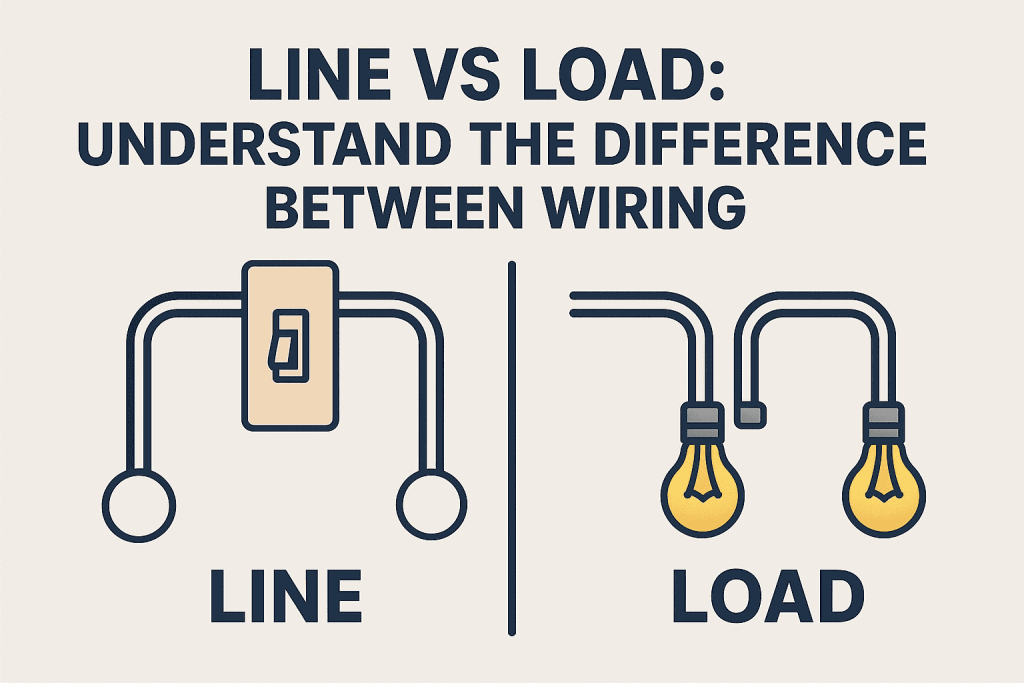
In electrical terminology, “line” and “load” describe a wire’s position relative to a single device – not the wire’s color or gauge. The line side of any device is where power arrives from the utility or panel. The load side is where power exits toward the next device downstream.
Think of a simple series of outlets on a 20-amp kitchen circuit. The first outlet receives its line feed directly from the breaker. Its load terminals connect to the second outlet’s line terminals. That second outlet’s load terminals continue to a third. Each device is simultaneously a load to the device upstream of it and a line source to the device downstream. The same logic applies at the service entrance: the utility feed arrives on the line side of the meter; the load side of the meter feeds the main breaker’s line terminals; that breaker’s load terminals feed the bus bars.
Many current GFCI receptacles are built to catch the basic version of this mistake. Leviton’s installation leaflet says its GFCIs will not reset if the LINE and LOAD leads are reversed (Leviton GFCI instructions). Other errors, such as landing a downstream cable on the LINE terminals, can still leave outlets without ground-fault protection.
Why the Distinction Matters Most on GFCI and AFCI Devices
Standard duplex outlets have no line/load distinction in practice – connect either black wire to the brass screw and the outlet powers on. The distinction becomes critical on protective devices such as GFCIs.
A GFCI (Ground Fault Circuit Interrupter) works by comparing current flowing out on the hot wire against current returning on the neutral. When the current going out differs from the current returning by approximately 5 milliamps, the device can shut off power in as little as 1/40 of a second (OSHA, GFCI). This comparison can only be performed on current passing through the device’s internal sensor – which means the GFCI must be wired so that the protected circuit flows through its load terminals. Wire the load circuit to the line terminals and the GFCI monitors only the feed from the panel, protecting nothing downstream.
A GFCI protects only what is wired through its LOAD terminals. If a downstream cable is landed on the LINE terminals instead, the GFCI can trip and reset normally while the outlets further down the circuit have no ground-fault protection. Test the outlets downstream as well as the GFCI itself.
AFCI (Arc Fault Circuit Interrupter) devices also have line and load connections, and the manufacturer’s instructions for each model must be followed. AFCI breakers sit inside the panel, which is work for a licensed electrician, not a DIY job.
How to Identify Line and Load Wires in the Field
Start with the markings and the cable count. Most GFCIs stamp LINE and LOAD on the device. If only one cable enters the box, it is the line cable, and it goes on the LINE terminals only (Leviton GFCI instructions). Turn off the breaker and confirm the circuit is dead with a tester before you pull a device out of the box. If the box holds more than one cable and you cannot tell which one is the feed, stop and call a licensed electrician. Sorting out the feed by testing live wires in an open box is not a homeowner job.
Wire labels are the definitive reference. Most GFCI devices stamp “LINE” and “LOAD” on the device and keep the two sets of terminals separate. Leviton’s leaflet describes a yellow sticker over the LOAD terminals and says not to remove it at the start of the install. Leave it in place unless you are connecting a cable that feeds downstream outlets.
When the wiring situation is unclear – multiple cables entering a single box, aluminum wiring, or knob-and-tube remnants – Brea Electric’s residential panel and rewiring services include a full circuit trace to confirm correct line and load termination throughout. We have been serving Orange County businesses and residents since 1932 (About Brea Electric).
Common Line/Load Mistakes and How to Correct Them
- GFCI outlet with reversed line/load: Many current GFCIs will not reset when LINE and LOAD are reversed, and no power reaches the outlet. If yours will not reset, turn the breaker off, confirm the circuit is dead with a tester, and compare which cable is on which terminals against the markings on the device. If you cannot tell which cable is the feed, stop and call a licensed electrician.
- Double-tapping the line terminals: Some installers connect both the incoming feed and the downstream cable to the LINE terminals, so the outlets downstream get no ground-fault protection from the GFCI. Each cable must connect to its correct terminal group.
- Unused load terminals: If nothing is fed from the GFCI’s load side, leave the factory sticker over the LOAD terminals and connect nothing to them.
- Generator connections: Never attach a generator directly to a home’s electrical system unless a qualified electrician has installed a transfer switch. Without one, the building wiring can energize the utility’s lines and create a risk of electrocution for utility workers and others in the area (OSHA, generator and electrical system safety). This is licensed-electrician work, not a DIY wiring job.
What is the difference between line and load wiring?
Line wires carry power into a device from the electrical source or panel. Load wires carry power out of the device to additional outlets or fixtures further along the circuit. The terms describe a wire’s position relative to a single device – not its color or gauge.
Does it matter if I swap line and load on a standard outlet?
On a standard duplex outlet with no protection function, swapping line and load connections typically does not affect operation – the outlet will still power devices. However, on GFCI and AFCI devices, reversing line and load can defeat the protection or stop the device from resetting. Always wire protective devices correctly.
How do I know which wire is line and which is load?
Read the LINE and LOAD markings on the device. If only one cable enters the box, it is the line cable. If the box holds more than one cable and you cannot tell which is the feed, stop and call a licensed electrician. Turn off the breaker and confirm the circuit is dead with a tester before you pull any device out of the box.
What happens if a GFCI outlet is wired with line and load reversed?
Many current GFCIs are built so they will not reset when LINE and LOAD are reversed, and no power reaches the outlet. A related mistake, landing a downstream cable on the LINE terminals, leaves the outlets downstream without ground-fault protection. Either way, turn the breaker off, confirm the circuit is dead, and call a licensed electrician if you cannot sort it out.
When should I call an electrician for line vs load wiring issues?
Call a licensed electrician when you have multiple cables entering a single box and cannot trace which is the panel feed, when the wiring is aluminum or older cloth-insulated wire, when a transfer switch or generator connection is involved, or any time you are unsure. Incorrect wiring on protective devices can defeat their safety function.
Key Takeaways
- Line wires bring power into a device; load wires carry power out to the next device downstream – the terms describe circuit position, not wire color.
- On GFCI and AFCI devices, reversing line and load can defeat the protection or stop the device from resetting.
- Read the LINE and LOAD markings on the device, and if a box holds more than one cable and you cannot tell which is the feed, stop and call a licensed electrician.
- A generator connected to a home without a properly installed transfer switch can backfeed onto utility lines – this is a life-safety issue, not just a code item.
- When multiple cables meet in one box or wiring origin is uncertain, a licensed electrician should perform a full circuit trace before any device is replaced.
References
- NFPA, Home Structure Fires (Hall and McGree, August 2025), https://content.nfpa.org/-/media/Project/Storefront/Catalog/Files/Research/NFPA-Research/Building-and-life-safety/oshomes.pdf?rev=7809c62e634445aa9e5b49a25ba65074
- OSHA, Ground-Fault Circuit Interrupters (GFCI) eTool, https://www.osha.gov/etools/construction/electrical-incidents/ground-fault-circuit-interrupters
- Leviton, Installing and Testing a GFCI Receptacle (instruction leaflet), https://leviton.com/content/dam/leviton/residential/product_documents/instruction_sheet/LC_MO_PDF_EL_7591_INSTRUCTION.pdf
- OSHA, Hurricane eMatrix: Restoring Electrical Utilities (generator and transfer switch), https://www.osha.gov/etools/hurricane/activity-sheets/infrastructure-repair/electrical
- Brea Electric, About Us, https://breaelectric.com/about-us/
From the desk of Brea Electric – Orange County’s electrical contractor since 1932. Visit breaelectric.com or call (714) 529-3030.