Brea Electric is the oldest business in Brea.

Uncategorized

Tenant Improvement Electrical Work in Orange County: A Contractor Guide

Tenant Improvement Electrical Contractor Orange County Tenant Improvement Electrical Work in Orange County: Avoiding the Delays That Derail Schedules TL;DR: Tenant improvement electrical work in Orange County is regularly the longest-lead trade on the critical path, not because the work is complex, but because permits, panel capacity issues, and coordination with property owners are often handled too late. This article covers what TI electrical scope involves, what drives cost and delay, and how to structure the process to keep the schedule intact. A medical group leased 4,200 square feet in an Anaheim office building. The general contractor had the space framed and ready for rough-in on day 14. The electrical subcontractor showed up on day 15 and found a 200-amp sub-panel serving the suite with 180 amps already committed to existing tenants on shared circuits. The panel had to be upgraded before a single outlet could be added. That discovery pushed the medical group’s opening by six weeks and cost $22,000 in scope change orders that should have been in the original bid. What TI Electrical Scope Actually Covers Power distribution. New branch circuits for workstations, equipment, and HVAC. Modern open-office plans with sit-stand desks and multiple monitors often require 2 to 3 circuits per 100 square feet where older TI standards assumed one. Panel assessment and upgrade. The single most common source of TI delay and cost overrun. A licensed commercial electrical contractor should perform a load study on the serving panel before the TI electrical bid is finalized. Lighting and controls. Most California TI projects trigger Title 24 Energy Code compliance requirements, which mandate LED lighting, occupancy controls, and daylight switching in perimeter zones. A 2023 study published in the Journal of Building Engineering found that Title 24 compliance provisions add an average of 12% to TI lighting costs compared to non-compliant specifications, but reduce long-term operating costs by 28% over a 10-year horizon. Data and structured cabling. CAT6 structured cabling and data line installation is increasingly included in the electrical subcontractor’s scope. Combining power and data rough-in under one trade eliminates coordination conflicts at the ceiling level and simplifies the permit and inspection process. Emergency and exit systems. Exit lighting and emergency egress lighting must meet IBC and CBC requirements on dedicated circuits complying with NEC Article 700. In TI work, existing emergency systems are often not properly documented. What Orange County Permit Offices Require for TI Electrical According to the City of Anaheim’s Building Division and the County of Orange Building and Safety, tenant improvement electrical permits require a complete electrical plan showing panel schedules, circuit layouts, load calculations, Title 24 compliance documentation, and equipment schedules for specialty occupancies. Plan check turnaround in Orange County cities runs 2 to 4 weeks for over-the-counter review and 3 to 6 weeks for complex projects. The most common cause of plan check rejection on TI electrical submittals is missing or incomplete load calculations. A professional electrical engineer stamp is required for most commercial TI projects above a certain square footage threshold, varying by jurisdiction. How to Structure the TI Electrical Process to Avoid Delays Panel load study before bid. Document the panel schedule and measure actual demand on serving circuits. New panel capacity can add $8,000 to $30,000 to the project. Electrical plan and Title 24 documentation prepared concurrently with architectural plans. The electrical permit can be submitted to the building department the same day as the architectural TI permit. Rough-in scope agreed and permitted before demo starts. Changes to rough-in scope after walls are open are exponentially more expensive than changes on paper. Low-voltage and data coordination completed before ceiling close-in. Structured cabling must be rough-in complete before the dropped ceiling goes up. Final inspection scheduled with 10-day lead time. Orange County building departments schedule final inspections 5 to 15 business days out. Schedule the appointment as soon as rough-in is signed off. Frequently Asked Questions What does tenant improvement electrical work cost per square foot in Orange County? Tenant improvement electrical costs in Orange County range from $12 to $35 per square foot depending on occupancy type and complexity. Standard office buildouts run $12 to $20 per square foot. Medical, dental, and laboratory spaces run $22 to $35 per square foot due to dedicated equipment circuits, isolated ground requirements, and emergency system complexity. What is Title 24 and how does it affect TI electrical scope in California? Title 24 is California’s Building Energy Efficiency Standards, updated every three years. For tenant improvements, Title 24 mandates LED lighting, occupancy sensors in most spaces, demand-responsive controls in larger facilities, and daylighting controls within 15 feet of windows in certain occupancy types. Any TI project that triggers a permit must comply with the current Title 24 edition. Does the property owner or the tenant pay for panel upgrades in a TI? This is negotiated in the lease. In most standard gross or NNN leases, base building infrastructure including the electrical panel is landlord responsibility. Tenant-specific distribution from the sub-panel through the suite is typically tenant or TI allowance scope. Defining the demarcation point in the lease before buildout begins is essential. Can data cabling be included in the electrical contractor’s scope? Yes, and combining power and low-voltage under one electrical contractor is often more efficient. It eliminates coordination conflicts at ceiling level, simplifies the permit, and ensures proper separation of power and data wiring per NEC Article 800. Brea Electric installs CAT6 structured cabling and data infrastructure as part of TI electrical scope. How far in advance should I engage a commercial electrical contractor for a TI project? Engage the electrical contractor before lease execution if possible, or at minimum 60 to 90 days before the scheduled construction start. The permit process, panel load study, and panel upgrade coordination all take time that cannot be compressed once the project is in motion. Brea Electric provides free pre-bid consultations for commercial TI projects across Orange County. Contact us at breaelectric.com. Key Takeaways Panel capacity assessment before bid finalization is the

Tenant Improvement Electrical Work in Orange County: A Contractor Guide Read More »

Warehouse and Commercial LED Lighting Retrofit: Costs, ROI, and What to Expect

Commercial LED Lighting Retrofit Orange County Commercial LED Lighting Retrofit in Orange County: Real ROI, Real Numbers TL;DR: A well-executed commercial LED lighting retrofit cuts lighting energy use by 50 to 75% and often pays back in 2 to 4 years after SCE rebates. This article covers actual project costs for Orange County warehouses and commercial spaces, how SCE’s Business Energy Solutions program works, and what separates a quality retrofit from a simple bulb swap. A distribution warehouse in Brea had 400-watt metal halide high bays, 180 of them, running 16 hours a day, six days a week. The facility manager had been looking at LED for three years but could not get through the project. The lighting worked; it was not urgent. Then the SCE bill hit $24,000 in a single month during a summer heat event, and the calculation changed. The LED retrofit quoted at $85,000 installed was approved within a week. With SCE rebates of $22,000 and annual energy savings of $31,000, payback came in 2.03 years. Why Metal Halide and T8 Fluorescent Systems Are Increasingly Uneconomical Metal halide and high-pressure sodium fixtures still common in warehouses and industrial facilities built before 2010 operate at 40 to 50% efficiency compared to modern LED. They also require 15 to 20 minutes to warm up to full output after a cold start or power interruption. A 2023 study published in Energy and Buildings evaluated 142 commercial lighting retrofit projects and found that facilities replacing metal halide with LED reported an average 68% reduction in lighting-related energy consumption, with a mean simple payback period of 2.7 years when utility incentives were captured. For California facilities operating under SCE’s commercial rate schedules, the energy cost per kilowatt-hour is among the highest in the continental United States, which accelerates payback compared to national averages. T8 fluorescent degrades meaningfully over time. Output drops to roughly 70% of initial lumens by the end of a rated 30,000-hour life. LED sources maintain 90%+ of initial lumens to 50,000 hours or beyond in commercial-grade fixtures. SCE Rebates and Incentive Programs for Orange County Businesses According to SCE’s Business Energy Solutions program documentation current as of Q1 2026, commercial customers replacing qualifying lighting fixtures can receive rebates of $20 to $100 per fixture. Warehouses replacing 400W metal halide high bays with 150 to 200W LED equivalents typically qualify for $80 to $100 per fixture. For a warehouse with 150 high bays, SCE rebates can total $12,000 to $15,000. SCE also offers on-bill financing for qualifying projects. Brea Electric handles SCE rebate paperwork as part of the project scope for all commercial LED lighting retrofits. What a Quality Commercial LED Retrofit Looks Like Photometric design. A photometric layout confirms that specified fixtures deliver required foot-candle levels at the work plane before anything is ordered. Controls integration. Commercial LED lighting design pairs with occupancy sensors, daylight harvesting controls, and dimming systems. A warehouse with motion-sensing high bays running at 30% in unoccupied aisles can cut energy use by an additional 20 to 35%. Fixture-grade specification. Brea Electric specifies fixtures from DLC-listed manufacturers with published L70 and L90 lumen maintenance data, 5 to 10 year warranties, and field-replaceable drivers. Branch circuit review. Replacing 400W metal halide with 150W LED changes the load on existing branch circuits. Circuits near capacity under metal halide loads often have capacity for additional fixtures or outlets after LED conversion. Frequently Asked Questions How much does a commercial LED lighting retrofit cost in Orange County? Commercial LED lighting retrofits in Orange County typically cost $50 to $150 per fixture installed. A 150-fixture warehouse retrofit runs $60,000 to $120,000 before SCE rebates. After rebates of $12,000 to $15,000, net project cost drops to $45,000 to $105,000, with simple payback of 2 to 4 years. How does the SCE Business Energy Solutions rebate program work? SCE’s Business Energy Solutions program pays commercial customers for replacing inefficient fixtures with qualifying LED equivalents. High-bay replacements in the 400W metal halide class typically qualify for $80 to $100 per fixture. SCE processes rebates within 60 to 90 days after project completion and inspection. Do LED retrofits require a permit in Orange County? It depends on scope. A direct fixture-for-fixture replacement often qualifies as a like-for-like replacement and may not require a permit. Projects that involve new wiring, added circuits, or controls system installation always require permits. What is the difference between a lighting retrofit and a relamp? A relamp replaces only the bulb or tube, leaving the existing fixture housing, ballast, and optics in place. A retrofit replaces the fixture entirely or installs a kit that replaces the light engine and driver while reusing the housing. For metal halide applications, relamp options are limited and typically less efficient than full fixture replacement. Does Brea Electric handle the SCE rebate paperwork? Yes. Brea Electric manages SCE rebate documentation, pre-installation fixture inventory, post-installation verification, and rebate submission for all commercial LED retrofit projects. Contact us at breaelectric.com for a free lighting assessment and ROI estimate. Key Takeaways Commercial LED retrofits deliver an average 68% reduction in lighting energy consumption, with a mean 2.7-year simple payback when utility rebates are captured, per a 2023 study in Energy and Buildings. SCE’s Business Energy Solutions program pays $80 to $100 per qualifying high-bay fixture replacement, a $12,000 to $15,000 offset on a typical 150-fixture warehouse project. Occupancy sensors and dimming controls add 20 to 35% additional energy savings on top of base LED efficiency gains. Include them in the retrofit scope. DLC-listed fixtures with published lumen maintenance data and field-replaceable drivers are the correct specification for commercial and industrial applications. Brea Electric handles full-scope commercial LED lighting retrofits including photometric design, SCE rebate documentation, and permit management for Orange County facilities. From the desk of Brea Electric. Orange County’s oldest electrical contractor, serving commercial and industrial customers since 1932. License C10. breaelectric.com

Warehouse and Commercial LED Lighting Retrofit: Costs, ROI, and What to Expect Read More »

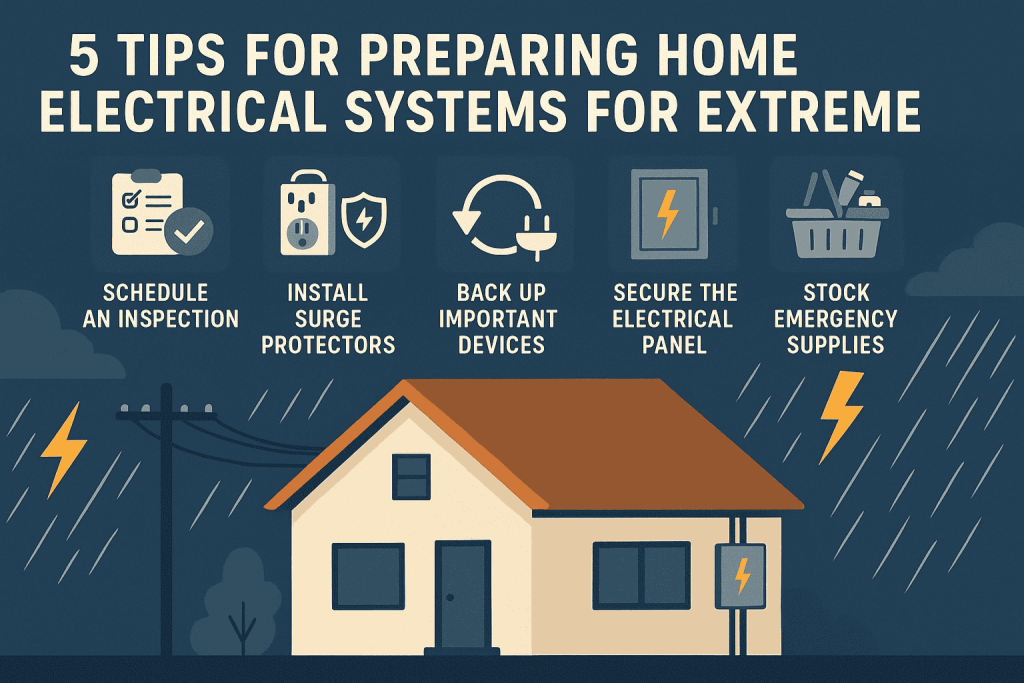
5 Tips for Preparing Home Electrical Systems for Extreme Weather

5 Tips for Preparing Home Electrical Systems for Extreme Weather

5 Tips to Protect Your Home Electrical System Before Extreme Weather Hits TL;DR: Extreme weather is the leading external cause of power outages and electrical damage in residential settings. Surge protection at the panel, GFCI protection in moisture-prone areas, generator interlock or transfer switch installation, and pre-event inspection of weatherhead and service entrance are the five actions with the highest return on investment before a major weather event. Southern California’s electrical infrastructure faces increasingly severe weather stress. The 2023 and 2024 winter storm seasons brought high-wind events that downed utility lines across Orange County, producing voltage spikes and extended outages. Summer heat waves pushed grid demand above 50,000 megawatts on multiple days, causing SCE to issue rotating outage warnings. When utility voltage surges, drops, or returns suddenly after an outage, residential electrical systems absorb the impact — and unprepared homes pay for it in damaged appliances, tripped breakers, and in the worst cases, fire from a saturated arc-fault circuit. Tip 1 — Install Whole-House Surge Protection Before the Season Changes A plug-in surge protector handles small surges at the device level. It does nothing to protect appliances without surge strips, HVAC equipment, water heaters, or any hardwired system. Whole-house surge protection installs at the service panel and intercepts surges before they reach any branch circuit in the home. A 2022 study published in the IEEE Transactions on Power Delivery found that utility-side voltage transients during grid restoration after outages exceeded 400V on 120V circuits in 17% of measured events — well above the 330V clamping voltage of most plug-in surge strips. Panel-mounted Type 1 and Type 2 surge protective devices (SPDs) provide a second stage of protection that absorbs the high-energy transients that pass through plug-in devices. The NEC 2020 edition (adopted in California effective 2023) requires whole-house SPDs on all new residential construction and service upgrades. For existing homes not subject to new construction requirements, adding an SPD to the main panel is a voluntary upgrade that typically costs $300–$600 installed — a fraction of a single HVAC unit replacement. Tip 2 — Verify GFCI Protection in All Moisture-Exposed Areas High-wind storms drive water into garages, under exterior doors, and into crawl spaces. Flooding events, even minor ones, create ground fault conditions at any outlet, appliance, or connection point contacted by standing water. GFCI protection trips within 1/40th of a second on a 5-milliamp ground fault — the threshold below which most adults survive contact. California code requires GFCI protection at all kitchen countertop outlets, bathroom outlets, garage outlets, exterior outlets, crawl space outlets, unfinished basement outlets, and any outlet within 6 feet of a sink. Existing homes are not required to retroactively add GFCI to pre-code outlets unless a circuit is modified, but verifying coverage before storm season is straightforward: use a GFCI outlet tester (available at any hardware store) on every outlet in the listed locations and press the TEST button on each GFCI device to confirm it trips and resets. According to the NFPA, ground fault protection prevents an estimated 75% of electrocution deaths that occur from consumer products. In storm conditions, GFCI protection is the most direct line of defense against electrical contact fatality in water-contacted areas. Tip 3 — Have Your Service Entrance and Weatherhead Inspected The service entrance is the point where utility lines connect to your home — the weatherhead (the curved conduit at the roof), the service entrance cable running to the meter, and the meter base itself. High-wind events pull on service drop cables, which can loosen weatherhead connections or, in severe cases, pull the service entrance cable off the house. A loose weatherhead connection creates an arcing fault at the service entrance — a high-energy arc that can ignite roofing material. Unlike a branch circuit fault that trips a breaker, a service entrance arc is upstream of the main breaker and cannot be cleared by any device inside the home. It requires utility disconnection to extinguish. Brea Electric’s residential panel upgrade service includes a full service entrance inspection as a standard component. For customers not scheduled for panel work, a pre-season service entrance check typically runs under $150 and addresses weatherhead attachment, drip loop adequacy, meter base condition, and service entrance cable clamp integrity. Tip 4 — Install a Generator Interlock or Transfer Switch Before You Need a Generator Portable generators become common during extended outages. They also become a source of backfeed injuries if connected without a proper transfer mechanism. Backfeed occurs when a generator connected through an extension cord to a house circuit sends voltage back out to the utility lines — lines that utility workers assume are de-energized during restoration work. A generator interlock kit installs at the main panel and mechanically prevents the main breaker and the generator input breaker from both being closed simultaneously. It is a code-compliant, low-cost ($50–$200 plus installation) solution that eliminates the backfeed path. A whole-house transfer switch provides a more complete solution — isolating the home from the utility entirely when generator power is selected — and enables a larger portion of the home’s loads to be managed during an outage. Brea Electric installs generator interlocks, manual transfer switches, and automatic transfer switches for both residential and commercial applications. Our 24/7 emergency electrical response service is available when weather-related damage requires immediate assessment or repair. Tip 5 — Check and Label Your Electrical Panel Before an Emergency During an extended outage with generator power, someone needs to selectively disconnect non-essential 240V loads to stay within the generator’s capacity. During a flood, someone may need to shut off specific circuits to de-energize areas while maintaining power to others. Both situations require a clearly labeled panel where every breaker’s circuit is identified accurately. Panel labeling takes one to two hours with two people — one at the panel toggling breakers, one walking the home confirming which outlets and fixtures lose power. Label every breaker. A label like “garage outlets + exterior lights” is more useful than “garage.” Note any multi-wire

5 Tips for Preparing Home Electrical Systems for Extreme Weather Read More »

Industrial Electrical Maintenance Contracts: What Orange County Facilities Should Expect

Industrial Electrical Maintenance Contracts Orange County Industrial Electrical Maintenance Contracts: What Orange County Facilities Should Demand TL;DR: Unplanned electrical failures cost industrial facilities an average of $260,000 per hour in downtime, far more than the annual cost of a proper maintenance contract. This article covers what an industrial electrical maintenance contract should include, how often different systems need attention, and what NFPA 70B and NEC compliance require. A food processing plant in Fullerton ran its electrical infrastructure on a reactive model: fix it when it breaks. Then a switchgear failure during peak production took 11 hours to diagnose and repair. The total loss exceeded $400,000. A maintenance contract with quarterly thermographic scanning would have identified the failing connection months earlier for roughly $6,000 per year. The math on preventive electrical maintenance is not subtle. Why Industrial Electrical Systems Degrade Without Intervention Industrial electrical systems face stresses that residential and light commercial installations do not. Thermal cycling from high motor loads expands and contracts connections thousands of times per year, loosening lugs and bus connections that were torqued to specification at installation. Vibration from compressors, presses, and conveyor systems works fasteners loose. Contaminants such as oil mist, metal dust, and chemical vapors degrade insulation and cause tracking faults on switchgear and motor starters. A 2021 study published in the IEEE Transactions on Industry Applications analyzed 847 industrial electrical failures over a five-year period. The study found that 67% of failures had detectable precursors an average of 14 months before the failure event. Detection requires instrumentation and scheduled inspection; it does not happen through casual observation. NFPA 70B, the 2023 edition, formally moved from recommended to mandatory language in several California jurisdictions, requiring documented maintenance programs for electrical equipment in industrial facilities. What the Industry Data Shows on Maintenance Costs and Payback According to the 2024 Plant Engineering Maintenance Study, facilities with formal electrical preventive maintenance programs experience 45% fewer unplanned electrical-related shutdowns than those operating reactively. The same study found that preventive maintenance programs generate $3.20 in avoided downtime costs for every $1.00 invested. The return on a well-structured industrial electrical maintenance contract is measurable within the first year for most Orange County industrial operations. What a Proper Industrial Maintenance Contract Covers Annual thermographic scanning. An IR camera survey of all electrical panels, switchgear, motor control centers, and bus connections identifies hot spots before they fail. Brea Electric’s electrical safety compliance inspection team performs IR scanning on all panel and MCC equipment as part of annual contracts. Quarterly panel inspections. Visual and tactile inspection of panel interiors: tighten connection lugs to manufacturer torque specifications, check for insulation damage, verify breaker operation, confirm labeling accuracy. NEC 110.3(B) requires that equipment be maintained in accordance with manufacturer instructions. Motor and drive maintenance. Industrial motors require periodic bearing inspection, insulation resistance testing, and alignment verification. Variable frequency drives need periodic inspection of cooling fans, capacitors, and DC bus voltage. Arc flash analysis and label updates. NFPA 70E requires that arc flash hazard analysis be kept current. When circuit breakers are added, fuses are changed, or utility service is modified, the arc flash incident energy calculations change. Arc flash studies should be updated every five years or after any significant system change. Emergency response priority. A maintenance contract customer receives priority response for unplanned failures. Brea Electric provides 24/7 emergency commercial and industrial electrical response to all maintenance contract customers. Structuring Your Maintenance Contract: Key Questions to Ask What is included vs. billed separately? Know the billing model before signing. Are NEC and NFPA 70B compliance reports provided? Written inspection reports documenting findings, corrective actions, and deficiencies are required if NFPA 70B applies to your facility. Is arc flash analysis included? If not, budget for it separately. What is the emergency response time commitment? Get the SLA in writing. Is thermographic scanning performed by a certified thermographer? Level II infrared certification through ASNT is the standard for industrial IR surveys. Frequently Asked Questions What does NFPA 70B require for industrial electrical maintenance? NFPA 70B (2023 edition) requires documented electrical equipment maintenance programs in some California jurisdictions. The standard specifies maintenance intervals for transformers, switchgear, motors, and cables, and requires that maintenance activities be documented with records retained. How often should industrial electrical panels be inspected? Industrial electrical panels should receive a visual and thermographic inspection at minimum annually, with connection torque checks at least every two years. Panels in high-vibration or high-humidity environments should be inspected quarterly. Can reactive maintenance replace a preventive maintenance contract? Reactive maintenance is consistently more expensive over any multi-year period. Emergency electrical repairs carry premium labor rates, expedited parts sourcing costs, and production downtime losses that dwarf the cost of planned maintenance. The 2024 Plant Engineering study found that reactive maintenance costs 3.2x more per repair event than scheduled work. What is arc flash analysis and why does it matter? Arc flash analysis calculates the incident energy released at each point in an electrical distribution system during a fault, which determines what PPE a worker must wear near energized equipment. NFPA 70E requires that all equipment where workers may be exposed to energized parts be labeled with arc flash hazard information based on a current analysis. What does Brea Electric’s industrial maintenance contract include? Brea Electric’s industrial electrical maintenance contracts include scheduled panel inspections, thermographic scanning, motor and drive checks, arc flash label verification, and written compliance reports. Contract customers receive priority scheduling and 24/7 emergency response. Contact us at breaelectric.com for a site assessment and contract proposal. Key Takeaways 67% of industrial electrical failures have detectable precursors an average of 14 months before failure. Thermographic scanning is the most effective early detection method, per IEEE research. Facilities with formal preventive maintenance programs experience 45% fewer unplanned electrical shutdowns, with a documented $3.20 return for every $1.00 invested. NFPA 70B (2023) now uses mandatory language in several California jurisdictions. Facilities without documented maintenance records face compliance exposure. Arc flash analysis must be kept current. Any significant system change invalidates

Industrial Electrical Maintenance Contracts: What Orange County Facilities Should Expect Read More »

Three-Phase Power Installation for Orange County Manufacturers

Three-Phase Power Installation Orange County Three-Phase Power Installation: What Orange County Facilities Need to Know TL;DR: Three-phase power delivers 73% more power per conductor than single-phase and is required for most industrial motors, CNC equipment, and large HVAC systems. This article covers what a new three-phase service costs, how SCE coordinates the installation, and what industrial facilities in Orange County should plan for. A machine shop in Anaheim added a second CNC lathe. The equipment arrived, the electrician ran the wiring, and the single-phase service could not handle the load. The owner paid for a three-phase conversion they had not budgeted, with a six-week SCE delay that pushed back production. This scenario plays out regularly in Orange County industrial corridors, where manufacturing facilities are expanding faster than their original electrical infrastructure was designed to support. What Three-Phase Power Actually Does Differently Single-phase power delivers current in one alternating wave. Three-phase power delivers three overlapping waves, offset by 120 degrees. For motors and rotating equipment, this difference is decisive: three-phase motors start smoother, run cooler, and last longer than their single-phase equivalents. They also produce about 150% of the torque of a same-size single-phase motor. A 2022 study published in IEEE Transactions on Energy Conversion documented that industrial facilities switching from single-phase to three-phase motor operation saw an average 18% reduction in motor energy consumption and a 23% reduction in motor maintenance costs over a 36-month period. For facilities with multiple motors, those numbers accumulate quickly. At 480V, the standard for industrial three-phase in California, a facility can run the same equipment on smaller-gauge wire than 240V single-phase requires for equivalent power. This reduces conductor cost on large installations and lowers resistive heat losses in long runs. The SCE Coordination Process in Orange County Southern California Edison serves most of Orange County’s industrial areas. Adding three-phase service where only single-phase exists requires a formal SCE service request. In most cases, SCE must install or upgrade a transformer on their distribution system before work begins on the customer side. According to SCE’s 2025 Electric Service Requirements Manual, commercial and industrial service requests involving new three-phase connections require a pre-application meeting, load letter, and site plan submission. SCE then performs a distribution system analysis to determine whether existing infrastructure can support the load. That process takes 4 to 10 weeks before SCE issues a service agreement. Total timeline from initial SCE application to energized service: 8 to 20 weeks, depending on SCE workload and whether transformer work is required on their side. How Industrial Facilities in Orange County Are Served The three-phase power installation process for a typical Orange County manufacturer involves four major phases: load engineering, SCE coordination, service entrance installation, and internal distribution wiring. Service entrance equipment for 480V industrial installations typically includes a pad-mounted or overhead transformer, a main meter base, a CT metering cabinet for larger services, and a main distribution panel rated for the service amperage. Brea Electric specifies Square D, Eaton, and Siemens gear with accessible parts and factory support. Internal distribution and motor control wiring is engineered to NEC Article 430 requirements, with properly sized overcurrent protection, disconnects within sight of each motor, and conductor sizing that accounts for continuous-duty motor currents. Planning a Three-Phase Installation: What to Do First Compile your equipment load list. List every motor, machine, and piece of equipment you are planning to run, with nameplate voltage, horsepower, and duty cycle. Submit the SCE pre-application early. The SCE distribution analysis is the longest-lead item in the project. Submit it while you are still planning the installation. Determine your metering configuration. Facilities over 200 kVA require instrument-transformer metering rather than direct-socket metering. Plan the service entrance location. NEC 230.70 and SCE requirements both mandate accessible service disconnects with adequate working clearance. Coordinate with equipment delivery schedules. Three-phase service activation is a date-certain milestone. Build in buffer. Frequently Asked Questions What does three-phase power installation cost in Orange County? A new three-phase service installation in Orange County typically costs $15,000 to $60,000 for the customer-side electrical work, depending on service amperage and internal distribution scope. SCE may charge separately for transformer work, ranging from $5,000 to $25,000. Can single-phase equipment run on a three-phase service? Yes. A three-phase distribution panel includes single-phase 120V and 240V branch circuits alongside three-phase circuits. Standard office equipment, lighting, and receptacles all run on single-phase legs derived from the three-phase service. How long does SCE take to approve a new three-phase service in Orange County? SCE’s distribution analysis typically takes 4 to 10 weeks from initial application. Total time from application to energized service has run 8 to 20 weeks for Orange County industrial projects in 2025. Starting the SCE process early is the most important scheduling decision a facility manager can make. Is 480V three-phase required for all industrial motors? Not always, but it is the standard for motors above 5 horsepower in California industrial applications. Most CNC equipment, industrial compressors, and commercial HVAC chillers above 10 tons are specified for 480V three-phase service. Does Brea Electric handle the SCE application process? Yes. Brea Electric manages the SCE pre-application, load letter submission, and service agreement coordination as part of the project scope. The firm handles all required permits and coordinates the final SCE energization inspection. Contact us at breaelectric.com for a free site assessment. Key Takeaways Three-phase power reduces motor energy consumption by an average of 18% and motor maintenance costs by 23%, per IEEE research. SCE’s distribution analysis for new three-phase service takes 4 to 10 weeks. It is the longest-lead item in any industrial power upgrade project. Submit the SCE pre-application before finalizing equipment purchase commitments to avoid production delays. 480V three-phase is the California industrial standard for motors above 5 HP. Brea Electric handles the full scope including SCE application, permits, service entrance installation, and motor control wiring through final inspection. From the desk of Brea Electric. Orange County’s oldest electrical contractor, serving commercial and industrial customers since 1932. License C10. breaelectric.com

Three-Phase Power Installation for Orange County Manufacturers Read More »

Commercial Electrical Panel Upgrade Costs in Orange County

Commercial Panel Upgrade Costs Orange County What a Commercial Electrical Panel Upgrade Actually Costs in Orange County TL;DR: Commercial panel upgrades in Orange County run $8,000 to $75,000+ depending on service size, panel type, and whether a utility upgrade is required. The 2023 NEC adopted by California in 2025 changed several code requirements that affect cost. This article breaks down the real numbers and what drives them. A 200-amp panel that served a retail strip tenant in 2005 often will not pass inspection today. It definitely will not support EV charging stations, modern HVAC, or expanded equipment loads. Facility managers across Orange County are discovering this the hard way when they pull permits for tenant improvements and the building department flags the existing service. A commercial electrical panel upgrade is one of the largest line items in any building improvement budget, yet most property owners are working from guesses rather than real cost data. Why Commercial Panel Costs Vary So Widely The range between $8,000 and $75,000 is not a contractor pricing mystery. Three variables drive most of that spread. Service amperage and voltage class. A 200-amp, 120/240V single-phase upgrade for a small retail space is straightforward. A 2,000-amp, 480/277V three-phase service for a manufacturing plant or large warehouse involves gear that costs $15,000 to $40,000 before labor. The utility (SCE in most of Orange County) may also require transformer upgrades on their side, which adds cost and lead time outside the contractor’s control. Code compliance scope. A 2024 study published in IEEE Transactions on Industry Applications found that electrical infrastructure in commercial buildings more than 20 years old requires an average of 2.3 additional code-compliance work items when a panel upgrade is permitted. These items include AFCI protection on branch circuits, updated grounding electrode systems, and service disconnect labeling. These are not optional; they are triggered by the permit. Physical relocation or gear replacement. If the existing panel is in a non-compliant location, it must be moved. Trenching, conduit, and meter base repositioning add $3,000 to $12,000 depending on distance and construction type. What the Data Shows on Commercial Electrical Costs According to the 2025 Electrical Contractor Magazine Industry Outlook Report, the average cost per amp for commercial panel capacity additions in California has risen 34% since 2020, driven by copper commodity prices, SCE interconnection delays, and prevailing wage requirements on publicly funded projects. Service Type Typical Size Estimated Cost Range Small retail / office 200A, single-phase $8,000 to $15,000 Medium commercial 400A to 800A, three-phase $18,000 to $40,000 Industrial / large warehouse 1,200A to 2,000A, 480V $40,000 to $75,000+ Utility-side transformer upgrade SCE-coordinated $5,000 to $25,000 How Brea Electric Approaches Commercial Panel Work A commercial panel upgrade at Brea Electric starts with a load calculation, not a ballpark. The existing service is metered under actual operating conditions, future loads are documented, and the correct service size is engineered before a permit application is filed. For facilities requiring 480V three-phase power, Brea Electric coordinates SCE service orders, specifies the correct meter base and CT cabinet, and handles all required inspections through Orange County jurisdictions where the firm has worked regularly since 1932. Steps to Budget a Commercial Panel Upgrade Accurately Request a load study first. Before any quotes, a licensed electrician should measure your actual peak demand. Check SCE availability. Transformer availability affects both cost and timeline. SCE lead times in Orange County have run 4 to 14 weeks in 2025. Pull the permit early. Orange County cities vary on plan-check turnaround. Anaheim runs 2 to 3 weeks; smaller cities can be faster. Get a fixed-price contract. Reputable commercial electrical contractors will provide a firm bid after the load study and permit pre-check. Plan for a utility shutdown window. SCE will schedule a service disconnect for the upgrade. Coordinate with tenants and building operations before locking in the project schedule. Frequently Asked Questions How long does a commercial electrical panel upgrade take in Orange County? Most commercial panel upgrades take 1 to 3 days of installation work, but the total project timeline runs 4 to 8 weeks when you include permit application, plan check, SCE service coordination, and final inspection. Larger 480V industrial upgrades can take 10 to 14 weeks if SCE transformer work is required. Does a commercial panel upgrade require a permit in Orange County? Yes. Any electrical service upgrade requires a permit from the local building department and final inspection by a city electrical inspector. Work done without a permit creates liability, voids insurance coverage, and must be disclosed during property sale. Can I upgrade just the panel without upgrading the main service from SCE? Sometimes. If the existing SCE service is already sized correctly, you may be able to replace an aging or undersized distribution panel without a utility upgrade. A load calculation determines whether the current service entrance is adequate. Is it cheaper to upgrade in phases rather than all at once? Usually not. Phased upgrades require multiple permit applications, multiple SCE service windows, and multiple mobilizations. Engineers and experienced commercial electrical contractors consistently recommend sizing the service for 10 to 15 years of projected load growth and doing it once. Does Brea Electric provide free estimates for commercial panel upgrades? Yes. Brea Electric provides free on-site estimates for all commercial electrical work, including panel upgrades, service changes, and load studies. Contact us at breaelectric.com to schedule. Key Takeaways Commercial panel upgrades in Orange County cost $8,000 to $75,000+ depending on service size, voltage class, and whether SCE transformer work is needed. California’s adoption of the 2023 NEC in 2025 added code-compliance requirements that increase scope on older buildings. Budget for them upfront. Request a professional load calculation before soliciting bids; it determines the correct service size and prevents costly change orders. SCE lead times for commercial service upgrades in Orange County have run 4 to 14 weeks. Start the utility coordination process early. Brea Electric offers free on-site estimates for commercial panel upgrades, with fixed-price contracts and permit management included. From the

Commercial Electrical Panel Upgrade Costs in Orange County Read More »

Accessibility Toolbar