
Neutral vs Ground Wire: What Each One Does and Why They Never Share a Job
Open a receptacle box and you will usually find a white wire and a bare copper one, and both of them lead back to the same panel. Plenty of homeowners figure that makes them interchangeable. They are not. Each wire has its own job. Mix them up and you can leave metal parts energized, trip your GFCIs, or hide a fault until someone gets hurt.
Here is what each wire does, why code keeps them apart, where they meet, and how to tell them apart. Code references follow the 2023 National Electrical Code (NEC). California adopts the NEC on its own schedule, and the California Building Standards Commission lists the 2025 California Electrical Code as the adoption of the 2023 NEC with amendments, effective January 1, 2026. Puzzled by the L and N markings on a fixture? Our post on what N and L mean in wiring covers that.
What the Neutral Wire Does
Every 120-volt circuit is a loop. Power leaves the panel on the hot wire, runs through the lamp or appliance, and comes back on the neutral. Any time the load is on, the neutral carries current. Treat it like any other working wire, because a damaged or disconnected neutral can still shock you.
NFPA’s grounding and bonding guide defines the grounded conductor as a conductor that is “intentionally grounded” and notes that electricians usually call it the neutral. The neutral is tied to earth at the service so the system has a stable reference point.
What the Ground Wire Does
The ground wire is formally the equipment grounding conductor. It connects the metal parts that are not supposed to carry current: the metal box, the frame of a dishwasher, the yoke of a receptacle. Under normal conditions it carries nothing.
Its job starts when a hot wire touches one of those metal parts. Now the frame is energized, and whoever touches it could become the path to the floor. The ground wire gives that fault current a low-resistance route back to the source instead. NFPA describes this as an effective ground-fault current path that lets breakers, fuses, and ground-fault detectors open properly. Put simply, the ground wire is what makes the breaker trip fast enough to matter.
Why They Are Separate Wires
Say one wire tried to do both jobs. The ground wire touches the metal of boxes and appliance frames. If it also carried return current all day, those metal parts would carry current all day, and a loose connection anywhere along that path could leave a frame energized with no fault ever recorded.
Flip it around and you get the same trouble, because a neutral that doubles as a ground cannot tell a normal load from a fault. So code splits the jobs. One wire handles working current, one handles fault current, and neither fills in for the other.
Why They Bond Only at the Main Panel
The neutral and ground are tied together on purpose, but only at one point: the service. NFPA calls that connection the main bonding jumper, the link between the grounded conductor and the equipment grounding conductor at the service. Federal workplace electrical rules say the same thing. OSHA 1910.304(g)(4) requires the equipment grounding conductor to connect to the grounded circuit conductor on the supply side of the service disconnecting means.
That single bond gives fault current a way back to the source, which is what lets the breaker open. Past that point, the two must stay apart. A second bond downstream would give return current a parallel path over the ground wire and any metal it touches.
Subpanels, like one in a garage or an addition, are where this bites hardest. Schneider Electric’s instructions for its QO and Homeline load centers say that when the panel is used as a subpanel, the green neutral bonding screw is not installed. Neutrals land on an insulated neutral bar and equipment grounds land on a separate ground bar.
Panel work like this belongs to a licensed electrician. Parts of a service panel stay energized even with the main breaker off, and the U.S. Consumer Product Safety Commission warns that panel boxes are usually live even with the main turned off.
What Happens If They Get Mixed Up
A few common mistakes, and what they cause:
- Neutral tied to ground downstream. Return current splits between the neutral and the ground path. Metal conduit, boxes, and equipment frames can carry current during normal use. Leviton’s support page lists a neutral tied to ground as a cause of GFCI and breaker tripping, and calls it a safety hazard and a code violation.
- Ground wire used as a neutral. The appliance may run fine, which is the problem. Nothing looks wrong while the ground path quietly carries working current. If that connection fails, the metal frame is part of the circuit.
- Line and load swapped on a GFCI. A related slip. Leviton’s GFCI instructions say the device has a lockout that prevents reset if the line and load leads are reversed.
A GFCI works by comparing current going out and coming back, and it trips when the two differ by about 5 milliamps, per OSHA. A neutral that wanders onto the ground path creates exactly that kind of imbalance, which is why GFCIs are often the first thing to complain.
How to Tell Them Apart
Start with color. NEC section 200.6 requires the grounded conductor (neutral) to be continuous white, continuous gray, or marked with three continuous white or gray stripes. NEC section 250.119 says equipment grounding conductors may be bare, or insulated with a green finish or green with one or more yellow stripes. NFPA summarizes both in the guide linked above.
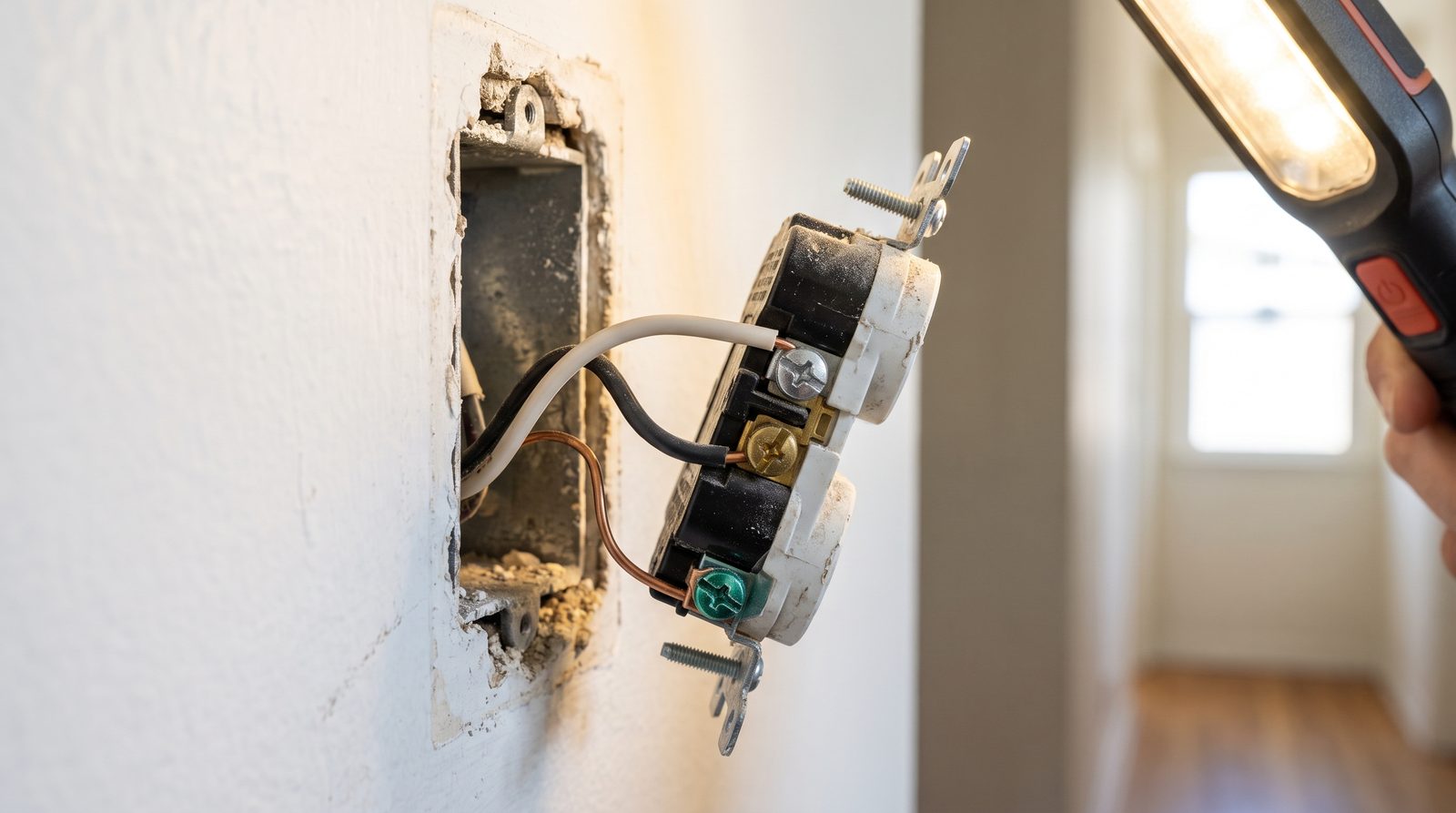
Terminals are the second clue. On a receptacle or GFCI, white wires go to the silver screw and hot wires go to the brass or black screw, while a bare copper or green wire goes to the grounding terminal. In a panel, neutrals land on the neutral bar and grounds land on the ground bar. On imported fixtures and many smart devices you may see N, L, and E. N is neutral and E is earth, the term used outside the United States for ground.
Color only gets you part of the way. NFPA notes that grounded conductors can also serve as phase conductors in certain applications, and older homes sometimes break the color rules. Our guide to understanding the colors of electrical wires covers the common exceptions. Before you touch any wire, turn off the breaker and confirm the circuit is dead with a tester. Do not rely on the label on the panel.
If you are chasing a tripping GFCI, a tingle from an appliance frame, or a panel that looks wrong, stop and call a licensed electrician. Brea Electric takes these calls through our residential electrical services, and our services page lists everything else we cover. Our FAQ answers common questions, or contact us at (714) 529-3030.
Can I connect the neutral and ground wires together at an outlet?
No. The neutral and ground are joined once, at the main service panel. Joining them again at an outlet puts return current on the ground path and metal parts, and it can make a GFCI trip. If you suspect a wiring mistake, have a licensed electrician check it.
Is the white wire always the neutral?
Usually, but not always. NFPA notes that grounded conductors can also be phase conductors in certain applications, and older wiring does not always follow the color rules. Turn off the breaker and confirm the wire is dead with a tester before you handle it.
Why are neutral and ground bonded in the main panel but separated in a subpanel?
The bond at the service gives fault current a path back to the source. A second bond in a subpanel would let normal return current flow over the ground wire and metal enclosures. Manufacturers such as Schneider Electric say the neutral bonding screw is left out when a load center is used as a subpanel.
What do N and E mean on a light fixture or smart switch?
N is the neutral terminal and E is the earth terminal, which is what other countries call ground. In a U.S. home, the neutral is the white or gray wire and the earth connection is the bare or green wire. Match the wire function to the terminal, not just the color.
Key Takeaways
- The neutral carries normal return current. The ground carries current only during a fault.
- The ground wire exists so a fault has a low-resistance path and the breaker trips quickly.
- Neutral and ground are bonded at the main service panel and kept apart everywhere downstream.
- A neutral tied to ground in the wrong place can trip GFCIs and put current on metal parts.
- Neutral is white or gray. Ground is green, green with yellow, or bare. Confirm with a tester, not color alone.
References
- NFPA, “Grounding and Bonding: Using the Tables in Article 250 of the NEC”
- OSHA, “1910.304 – Wiring design and protection”
- OSHA, “Electrical Incidents – Ground-Fault Circuit Interrupters (GFCI)”
- Schneider Electric, “How should the branch neutrals and equipment ground conductors be terminated in a QO or Homeline load center which is applied as a sub-panel?”
- Leviton, “The Circuit Breaker or GFCI Outlet Trips when I try to Turn the Light On”
- Leviton, “Installing and Testing a GFCI Receptacle” (instruction sheet)
- California Building Standards Commission (DGS), “January 1, 2026 – 2025 Title 24, Part 3, California Electrical Code (errata)”
- U.S. Consumer Product Safety Commission, “Preventing Home Fires: Arc Fault Circuit Interrupters (AFCIs)”
From the desk of Brea Electric – Orange County’s electrical contractor since 1932. Visit breaelectric.com or call (714) 529-3030.