
EV Charger Installation in Orange County: What Every Driver Needs to Know
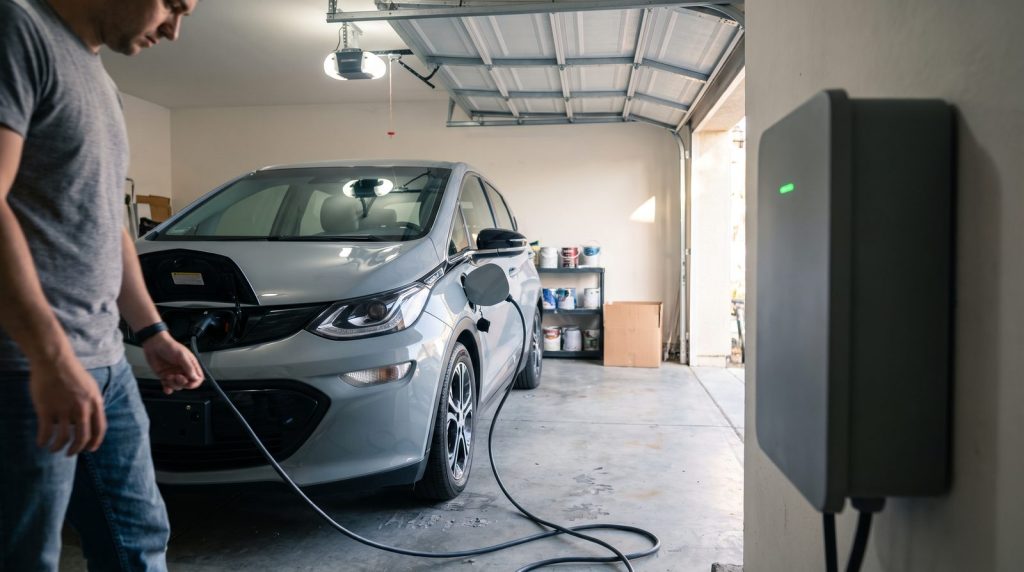
California passed 2.5 million cumulative new zero-emission vehicle sales in 2025, and the California Energy Commission estimates about 800,000 chargers are already installed in California homes (CEC, January 2026). If you drive one in Brea or anywhere in Orange County, the daily question is how it gets charged overnight. A plug in the garage wall works for some drivers. For most, the real answer is a proper circuit. This guide covers what that takes, what the city checks, what it costs, and where commercial jobs differ. If you are still deciding whether home charging is worth it, our post on the benefits of home EV charger installation covers that side.
Why Charging Speed Comes Down to Your Circuit
The U.S. Department of Energy gives rough numbers for each type of charging (Alternative Fuels Data Center):
- Level 1 (a standard 120-volt outlet) adds about 5 miles of range per hour. Eight hours overnight is roughly 40 miles for a mid-size EV.
- Level 2 (240 volts) adds about 25 miles per hour.
- DC fast charging adds roughly 100 to 200 miles or more in 30 minutes, uses three-phase power, and is built for corridors and depots rather than houses.
Your circuit sets the pace. A driver who commutes 40 miles each way will not recover that on a wall outlet overnight, and the gap grows every week. The National Renewable Energy Laboratory found that early EV charging patterns are home-dominant, with more than 80 percent of charging done at home (NREL, 2023). So the home installation matters more than most people expect.
Which Connector Does Your Car Use?
Tesla’s charging connector, known as NACS, was standardized as SAE J3400. SAE published a technical report in December 2023 and the recommended practice in September 2024 (SAE). Plenty of non-Tesla cars still have the older J1772 port, and the DOE lists both connector types for Level 2 equipment. Pick a charger that matches your car’s inlet, or confirm adapter support with both the charger and vehicle makers before you buy.
What Circuit and Panel Does a Home Charger Need?
An EV charger counts as a continuous load, so the circuit has to be sized at 125 percent of the charger’s output. Brea’s own permit checklist asks about this directly: is the charging circuit sized for a continuous load (125%)? A 48-amp charger therefore goes on a 60-amp breaker. The Tesla Wall Connector is a common example. It can be set anywhere up to 48 amps (11.5 kW), with 60 amps needed only for full output, and lower settings can run on smaller breakers (EnergySage review).
Whether your panel can carry that is a calculation, not a rule of thumb. Brea requires an electrical load calculation worksheet with every Level 2 permit application. The Clean Energy Connection reports that most California houses can install an EV charger without a panel upgrade, as long as the panel has at least 100 amps and is in good condition (Clean Energy Connection). So a 200-amp panel is not a requirement.
An upgrade comes into play when the load calculation shows no room, when there is no breaker space, or when the panel itself is a problem. Older panels with known problems, such as Federal Pacific Stab-Lok or Zinsco, are worth replacing before you add a high-draw circuit. If you are in that situation, our residential electrical services cover panel upgrades alongside the charger, and one permit visit can often cover both.
Code Details That Matter
Dedicated Circuit
The charger gets its own circuit. No shared breakers, no sharing a circuit with the garage freezer.
GFCI Protection
Under NEC section 625.54, receptacle outlets installed for EV charging need GFCI protection for personnel. That is the 2020 and 2023 editions of the code (Building Code Geek summary). In practice, a plug-in charger on a NEMA 14-50 outlet usually needs a GFCI breaker. A hardwired charger is a different case, because many units include ground-fault protection as part of their listing. Ask your electrician which applies to the unit you bought. California’s 2025 Electrical Code, which adopts the 2023 NEC, took effect January 1, 2026 (California Electrical Code 2025). Garages and outdoor outlets also have separate GFCI rules under section 210.8, so a garage outlet can trigger protection even apart from EV rules.
Weather Rating
If the charger sits in a carport or on an exterior wall, it has to be listed for outdoor use, and so does the conduit run. The Wall Connector is rated NEMA 3R (EnergySage). Check the listing on any other unit before you mount it outside.
Off-Peak Charging
Many EV owners in Southern California Edison territory qualify for the TOU-D-PRIME rate plan. SCE lists its highest rates from 4 p.m. to 9 p.m. every day (SCE). Most chargers can be scheduled from an app, so the car charges outside that window. Rates and enrollment rules change, so check SCE before you rely on a number.
Permits and Inspection in Brea
California law pushes cities toward fast approvals for EV chargers. AB 1236 (2015) requires cities and counties to approve qualifying charger applications administratively. AB 970 (2021) added deadlines: an application is deemed complete after 5 or 10 business days, and deemed approved after 20 or 40 business days if the city does not act, depending on how many chargers are proposed (Allen Matkins). A permit is still required, and the inspection still happens.
For a Level 2 charger at an existing Brea home, the city’s checklist asks for the checklist itself, an electrical load calculation worksheet, a permit application, a site plan, a single-line diagram, and the manufacturer’s specifications. Level 2 installations carry a plan check fee (City of Brea). If you also need a main panel replaced, Brea’s fee schedule updated July 1, 2026 lists $285 for that permit (City of Brea). Fees change, so confirm with the Building and Safety Division. Other Orange County cities run their own counters and checklists.
What an EV Charger Installation Costs
Nobody can give you a real number before looking at your garage and panel. The Clean Energy Connection gives general California estimates: around $500 to $1,500 for a straightforward Level 2 install, meaning a short run from the panel to the garage and no panel upgrade, and $4,000 or more for a complex one, such as a garage on the opposite side of the house from the panel or a panel upgrade. Those figures are a starting range, not a quote. The main cost drivers are the distance from the panel, the charger you buy, whether the panel needs work, and permit fees. Ask for a written quote after a site visit, and make sure it lists the permit.
Commercial and Workplace EV Charging
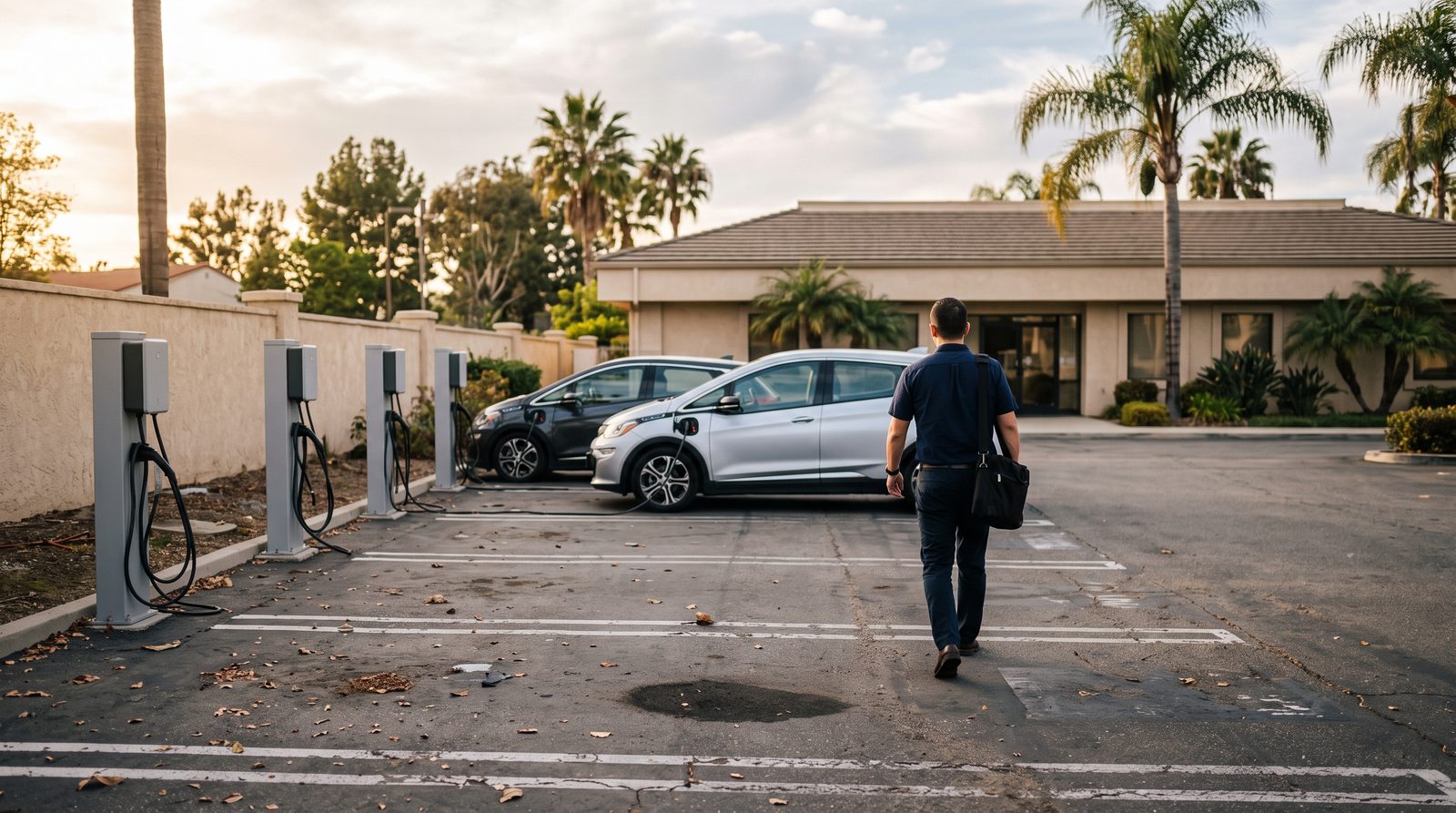
Businesses, apartments, and parking facilities add questions a house does not have: several chargers on one service, metering, and how much load the existing service can carry. Brea Electric installs Level 2 chargers for workplaces and parking facilities, including permits, engineered plans, and load calculations. Our commercial electrical services page lists that work, and our post on commercial panel upgrade costs in Orange County explains the service side.
DC fast charging is a different job. The DOE describes DC fast chargers as typically using three-phase AC input, with power outputs up to 500 kW. That usually means a larger service and coordination with the utility. SCE’s Rule 29 covers service extensions for EV charging, and its Rule 15 covers distribution line extensions, so a big project may involve both (SCE Rule 29). SCE has also run Charge Ready programs to help fleet customers with the cost of charging infrastructure (SCE). Ask SCE which programs are open now. If your project needs DC fast charging, call us first, and we will tell you plainly whether it fits our work.
EV Charging Level Comparison
| Charging Level | Voltage | Typical Circuit | Range Added (DOE) | Typical Use |
|---|---|---|---|---|
| Level 1 | 120 V | Standard 15 or 20 amp outlet | About 5 miles per hour | Occasional use, plug-in hybrid top-off |
| Level 2 | 240 V | Dedicated circuit sized to the charger | About 25 miles per hour | Home, workplace, multi-unit parking |
| DC fast charging | Three-phase AC input | Commercial service with utility coordination | About 100 to 200+ miles per 30 minutes | Highway corridors, fleet depots |
Frequently Asked Questions
How much does it cost to install a Level 2 charger at home in California?
The Clean Energy Connection estimates about $500 to $1,500 for a straightforward install with a short run and no panel upgrade, and $4,000 or more for a complex one. Your price depends on distance from the panel, the charger, panel condition, and permit fees. Get a written quote after a site visit.
What connector does my EV use?
Tesla vehicles use the NACS connector, now standardized as SAE J3400. Many other EVs still use the older J1772 connector. Match the charger to your car’s inlet, or confirm adapter support with the charger and vehicle makers before you buy.
Does my panel need an upgrade before I install an EV charger?
Not always. The Clean Energy Connection reports that most California homes can add a charger without a panel upgrade if the panel has at least 100 amps and is in good condition. A load calculation by a licensed electrician decides it. Older panels with known problems, such as Federal Pacific Stab-Lok or Zinsco, are worth replacing first.
Is a permit required for an EV charger in Brea?
Yes. California law speeds up approvals through AB 1236 and AB 970, but the permit and the inspection still apply. For a Level 2 charger, Brea’s checklist asks for a load calculation, a site plan, a single-line diagram, and the manufacturer’s specifications, and a plan check fee applies.
Does Brea Electric install EV chargers for businesses?
Yes. We install Level 2 chargers for workplaces and parking facilities, including permits, engineered plans, and load calculations. If you need DC fast charging, call us first so we can tell you whether it fits our work. Contact us to schedule an assessment.
Key Takeaways
- Level 2 charging adds about 25 miles of range per hour, compared with about 5 on a standard outlet, according to the Department of Energy.
- A charger is a continuous load, so its circuit is sized at 125 percent. A 48-amp charger takes a 60-amp breaker.
- Most California homes with a 100-amp panel in good condition can add a charger without an upgrade. A load calculation decides.
- Plug-in chargers on a receptacle need GFCI protection under NEC 625.54. Check what applies to a hardwired unit.
- Brea needs a load calculation and a permit for every Level 2 charger. Get a written quote that includes the permit, and ask for a site visit before you buy a charger.
References
- California Energy Commission, “California Surpasses 2.5 Million ZEV Sales”, https://www.energy.ca.gov/news/2026-01/california-surpasses-25-million-zev-sales
- U.S. Department of Energy, Alternative Fuels Data Center, “Electric Vehicle Charging Stations”, https://afdc.energy.gov/fuels/electricity-stations
- National Renewable Energy Laboratory, “Modeling U.S. Light-Duty Demand for EV Charging Infrastructure in 2030”, https://docs.nlr.gov/docs/fy23osti/86980.pdf
- SAE International, “J3400_202409: North American Charging System (NACS) for Electric Vehicles – Recommended Practice”, https://saemobilus.sae.org/standards/j3400_202409-north-american-charging-system-nacs-electric-vehicles
- Clean Energy Connection, “Average Cost to Install an EV Charger at Home in California”, https://cleanenergyconnection.org/article/whats-average-cost-install-ev-charger-home-california
- EnergySage, “Tesla Wall Connector Gen 3 review: Still the Old Reliable of home EV charging”, https://www.energysage.com/ev-charging/ev-charging-stations/tesla-gen-3-ev-charger-review/
- Building Code Geek, “EVSE GFCI Requirements NEC 2020 And 2023 Explained”, https://buildingcodegeek.com/evse-gfci-requirements-nec-2020-2023/
- UpCodes, “California Electrical Code 2025 based on the NFPA 70, 2023”, https://up.codes/viewer/california/ca-electric-code-2025
- Southern California Edison, “Time of Use Plans”, https://www.sce.com/save-money/rates-financing/residential-rate-plans/time-of-use-plans
- Allen Matkins, “California Laws Related to Permitting Electric Vehicle Charging Stations and Electric Infrastructure Projects”, https://www.allenmatkins.com/real-ideas/california-laws-related-to-permitting-electric-vehicle-charging-stations-and-electric-infrastructure-projects.html
- City of Brea, “2022 Checklist for Installing Residential Electric Vehicle Charging Station (EVCS) at Existing Facilities”, https://cityofbrea.gov/DocumentCenter/View/15115/2022-Checklist-for-Installing-Residential-Electric-Vehicle-Charging-Station
- City of Brea, “Development Fees (updated 07/01/2026)”, https://cityofbrea.gov/DocumentCenter/View/13483/Development-Processing-Fees—UPDATED-06302026
- Southern California Edison, “Electric Rule 29, Cal. PUC Sheet No. 73478-E”, https://www.sce.com/sites/default/files/custom-files/PDF_Files/ELECTRIC_RULES_29.pdf
- Energized by Edison, “Charge Ready Transport Advances Despite Pandemic-Related Challenges”, https://energized.edison.com/stories/charge-ready-transport-advances-despite-pandemic-related-challenges
From the desk of Brea Electric – Orange County’s electrical contractor since 1932. Visit breaelectric.com or call (714) 529-3030.