
Commercial LED Lighting Retrofit in Orange County: What Drives Cost and Payback
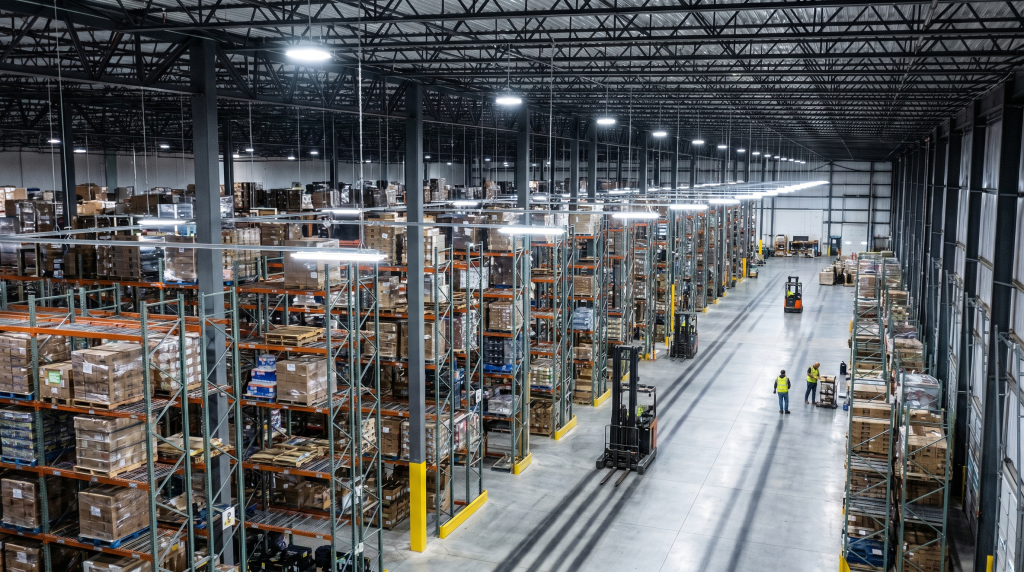
Picture a distribution warehouse with 400-watt metal halide high bays running long hours, six days a week. The facility manager has been looking at LED for years, but the lighting works, so it never feels urgent. Then a summer electric bill arrives that is much higher than expected, and the calculation changes. This is an illustrative scenario, not a specific project. Long operating hours and high California electricity prices are what make high-bay retrofits attractive: the EIA reports an average California commercial electricity price of 30.56 cents per kilowatt-hour in July 2026, against 14.53 cents for the U.S. average (EIA Electric Power Monthly, Table 5.6.A).
Why Metal Halide and T8 Fluorescent Systems Are Increasingly Uneconomical
Metal halide and high-pressure sodium fixtures are still common in warehouses and industrial facilities. Metal halide lamps have a warm-up time measured in minutes and a longer restrike time after being switched off, which discourages the use of automatic controls (Vesma, LED versus metal halide lamps). LED fixtures can be controlled without that delay. The U.S. Department of Energy found that low and high bay applications produced the greatest LED energy savings of any application it evaluated in 2018 (DOE, 2020 Adoption of LEDs in Common Lighting Applications).
Savings from replacing metal halide with LED vary by project. Fixture wattage, operating hours, controls, and electricity rates all change the result. California commercial electricity prices are well above the national average (see the EIA figures above), which shortens payback compared with many other states. Ask for a calculation based on your own fixture count, wattage, and hours before you commit.
Fluorescent lamps lose light output as they age. LED fixtures are rated by lumen maintenance, the hours until output falls to a set percentage of the original (L70 means 70%, L90 means 90%), which lets you compare fixtures using published test data. The DesignLights Consortium requires L70 lumen maintenance for DLC Standard products and L90 for DLC Premium (DLC SSL FAQ).
SCE Rebates and Incentive Programs for Orange County Businesses
SCE offers business energy efficiency incentives through its Express Solutions and Customized Solutions programs, and publishes a Solutions Directory that lists eligible equipment and qualification criteria. Rebate amounts depend on the fixture type, wattage, and program rules in effect when you apply, so get the current figure from SCE or your contractor before you set a budget. Many utility programs use the DesignLights Consortium Qualified Products List to decide product eligibility (DLC says nearly 700 programs require it), so ask SCE whether your fixtures must be DLC-listed.
SCE also offers On-Bill Financing for qualifying business projects: 0% interest, no fees, repayment on the monthly SCE bill, a $5,000 minimum, up to $250,000 for business customers, and terms up to five years or the measure’s useful life, whichever is shorter. To qualify you must apply for one or more qualifying incentive programs and keep an active SCE account in good standing (SCE On-Bill Financing; confirm current terms). Brea Electric handles SCE rebate paperwork as part of the project scope for all commercial LED lighting retrofits.
What a Quality Commercial LED Retrofit Looks Like
Photometric design. A photometric layout confirms that specified fixtures deliver required foot-candle levels at the work plane before anything is ordered.
Controls integration. Commercial LED lighting design pairs with occupancy sensors, daylight harvesting controls, and dimming systems. In a Lawrence Berkeley National Laboratory meta-analysis of 88 studies, average lighting energy savings were 24% for occupancy-based controls and 28% for daylighting controls (LBNL, Lighting Controls in Commercial Buildings). A warehouse with motion-sensing high bays that dim in unoccupied aisles can capture part of that, but real savings depend on how the space is used.
Fixture-grade specification. Brea Electric specifies fixtures from DLC-listed manufacturers with published L70 and L90 lumen maintenance data, warranties of at least five years (the DLC minimum), and field-replaceable drivers.
Branch circuit review. Replacing 400W metal halide with 150W LED changes the load on existing branch circuits. Circuits near capacity under metal halide loads often have capacity for additional fixtures or outlets after LED conversion.
Frequently Asked Questions
How much does a commercial LED lighting retrofit cost in Orange County?
Cost per fixture depends on fixture type and wattage, mounting height and lift access, controls, wiring changes, and the number of fixtures. Get a written quote based on a fixture count and a photometric layout. Subtract any incentives and look at financing options, such as SCE On-Bill Financing, before you calculate payback.
How do SCE’s business lighting rebates work?
SCE’s Express Solutions program offers cash rebates to business customers who replace equipment with qualifying high-efficiency equipment, and its Customized Solutions program offers incentives for new high-efficiency equipment or systems (SCE Business Electricity Savings). Eligible equipment, rebate amounts, and processing steps are set by the program, so check SCE’s Solutions Directory or ask your contractor before you buy fixtures.
Do LED retrofits require a permit in Orange County?
It depends on scope and on your city, so ask the building department before you start. Projects that involve new wiring, added circuits, or controls installation commonly need an electrical permit. Separately, under the 2025 California Energy Code, which applies to permits applied for on or after January 1, 2026 (California Energy Commission), altering 10% or more of the luminaires serving an enclosed space triggers lighting power and control requirements, with some exceptions such as changes limited to lamps, ballasts, or drivers (2025 Energy Code, Section 141.0(b)2I, restructured version for information only). California may amend the code, so confirm current rules with your city.
What is the difference between a lighting retrofit and a relamp?
A relamp replaces only the bulb or tube, leaving the existing fixture housing, ballast, and optics in place. A retrofit replaces the fixture entirely or installs a kit that replaces the light engine and driver while reusing the housing. For metal halide applications, LED replacement lamps exist, but DOE notes they are less efficient than LED luminaires (DOE, 2020 LED adoption report).
Does Brea Electric handle the SCE rebate paperwork?
Yes. Brea Electric manages SCE rebate documentation, pre-installation fixture inventory, post-installation verification, and rebate submission for all commercial LED retrofit projects. Contact us at breaelectric.com for a free lighting assessment and ROI estimate.
Key Takeaways
- LED retrofit savings and payback depend on fixture wattage, operating hours, controls, electricity rates, and incentives, so get a calculation for your building. California commercial electricity prices were more than double the U.S. average in EIA’s July 2026 data.
- SCE offers business incentives through its Express Solutions and Customized Solutions programs, plus 0% On-Bill Financing for qualifying projects. Confirm current rebate amounts and rules with SCE before you buy.
- Lighting controls can cut energy use further: LBNL’s meta-analysis found average savings of 24% for occupancy-based controls and 28% for daylighting controls. Include them in the retrofit scope where the space allows.
- DLC-listed fixtures with published lumen maintenance data and field-replaceable drivers are the correct specification for commercial and industrial applications.
- Brea Electric handles full-scope commercial LED lighting retrofits including photometric design, SCE rebate documentation, and permit management for Orange County facilities.
References
- U.S. Energy Information Administration, Electric Power Monthly, Table 5.6.A (average price of electricity by state and sector), https://www.eia.gov/electricity/monthly/epm_table_grapher.php?t=epmt_5_6_a
- Southern California Edison, Business Electricity Savings (Express Solutions and Customized Solutions), https://www.sce.com/business/ems
- Southern California Edison, Save Costs and Energy (business programs), https://www.sce.com/business/save-costs-energy
- Southern California Edison, On-Bill Financing Program, https://www.sce.com/business/rates-financing/energy-efficiency-financing/on-bill-financing
- DesignLights Consortium, LED/Solid-State Lighting FAQs, https://designlights.org/resources/knowledgebase/faq/ssl/
- DesignLights Consortium, Quick Facts, https://designlights.org/fact-sheet/
- Lawrence Berkeley National Laboratory, Lighting Controls in Commercial Buildings (meta-analysis), https://energyanalysis.lbl.gov/publications/lighting-controls-commercial
- U.S. Department of Energy, 2020 Adoption of Light-Emitting Diodes in Common Lighting Applications, https://www.energy.gov/cmei/ssl/articles/2020-led-adoption-report
- Vilnis Vesma, LED versus metal halide lamps, https://www.enmanreg.org/led_vs_mh/
- California Energy Commission, 2025 Building Energy Efficiency Standards (effective January 1, 2026), https://www.energy.ca.gov/programs-and-topics/programs/building-energy-efficiency-standards/2025-building-energy-efficiency
- California Energy Commission, 2025 Energy Code (restructured, for information only), Section 141.0(b)2I altered indoor lighting systems, https://www.energy.ca.gov/sites/default/files/2025-11/Restructured_2025_Energy_Code_-_California_Code_of_Regulations_-_Title_24_Part_6_(For_Information_Only)_ada.pdf
From the desk of Brea Electric. Orange County’s oldest electrical contractor, serving commercial and industrial customers since 1932. License C10. breaelectric.com